
Drone Roof Inspection: Amazing Benefits
Drone Roof Inspection: Essential Tips
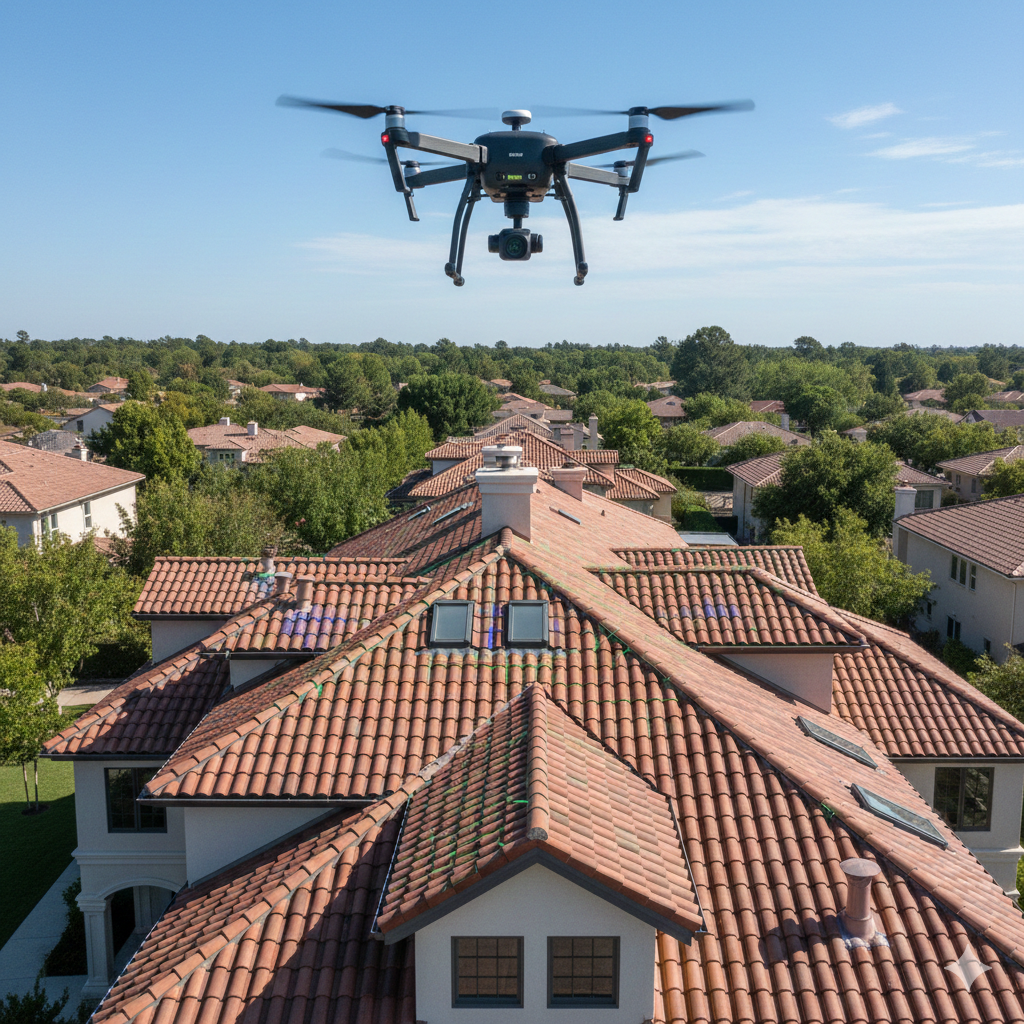
Drone roof inspection has emerged as a revolutionary technology that transforms how property owners, contractors, and insurance companies assess roofing conditions. This advanced method combines cutting-edge aerial technology with high-resolution imaging to deliver safer, faster, and more accurate roof assessments compared to traditional manual inspections. Whether you’re a homeowner seeking routine maintenance or a professional looking to expand your service offerings, understanding drone roof inspection is essential in today’s digital age.
What Is Drone Roof Inspection
Drone roof inspection refers to the process of using unmanned aerial vehicles (UAVs) equipped with specialized cameras and sensors to examine roofing systems without requiring physical access. These commercial-grade drones carry high-resolution cameras, zoom lenses, and thermal imaging technology that capture comprehensive visual data of roof surfaces. The technology identifies hidden issues such as water ingress, heat loss, missing tiles, and deteriorating materials with exceptional accuracy.
The inspection process involves flying a drone over the property to capture detailed imagery from multiple angles, providing a complete view of areas that would otherwise be difficult or dangerous to access. Modern drone roof inspection systems automatically geotag images with coordinate information, keeping positional data organized and ready for integration into mapping or Building Information Modeling (BIM) software. This method represents a fast, safe, and highly effective approach to roof assessment suitable for both residential and commercial properties.
How Drone Roof Inspection Works
Understanding how drone roof inspection operates requires examining the systematic process from planning to reporting. The inspection begins with pre-flight checks where operators verify battery levels, camera functionality, GPS signal strength, and weather conditions. Once cleared for operation, pilots use flight-planning software to program the automated mission by tracing the building’s perimeter on a satellite map.
The software then configures specific flight parameters including altitude, image overlap (typically 75%), and camera gimbal angles to capture either straight-down or angled shots. After uploading the flight plan, the drone autonomously flies the predetermined grid pattern while maintaining constant altitude and speed to ensure consistent data capture. Throughout the automated flight, the operator serves primarily as a safety observer, monitoring for obstacles and ensuring smooth operation.
Upon completion, captured images are imported into specialized photogrammetry software that analyzes GPS geotags and stitches images together to create high-resolution orthomosaic maps and accurate 3D models. Inspectors then systematically analyze these outputs to identify damage such as cracked shingles, popped nails, rusted flashings, and gutter blockages, digitally tagging each issue directly on the images. The entire drone roof inspection typically takes 15-30 minutes for flight operations, followed by several hours of data processing depending on project size.
How to Find Professional Drone Roof Inspection Services
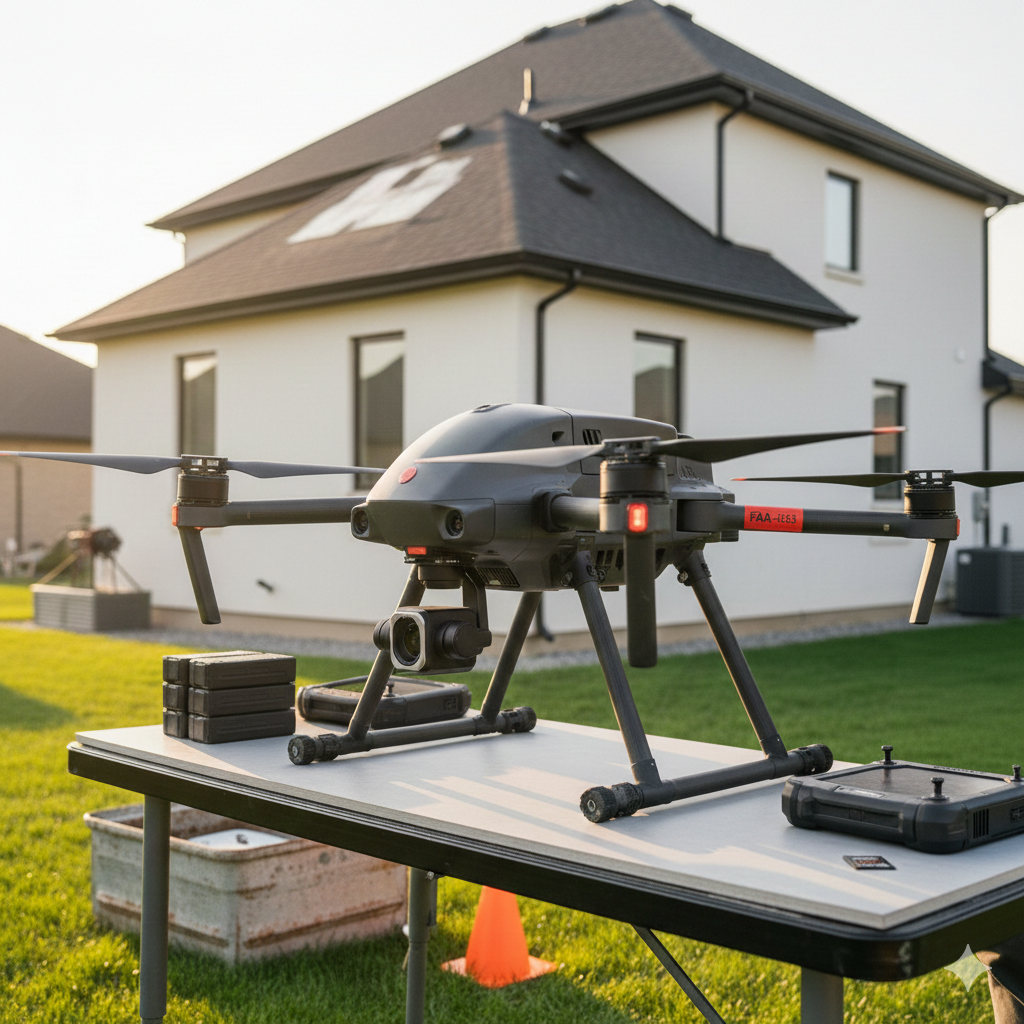
Locating qualified drone roof inspection providers requires evaluating several critical factors to ensure quality and compliance. Start by verifying that operators hold FAA Part 107 Remote Pilot Certificates, which demonstrate they have passed the required written examination and understand airspace rules, emergency procedures, and weather management. This certification is mandatory for all commercial drone operations in the United States.
When searching for providers, consider the following selection criteria:
Review their portfolio and experience – Examine previous inspection projects and client testimonials
Verify insurance coverage – Ensure they carry liability insurance for drone operations
Assess equipment quality – Confirm they use professional-grade drones with high-resolution cameras (minimum 20MP stills, 4K video)
Check thermal imaging capabilities – For comprehensive inspections, thermal sensors detect moisture intrusion and heat loss
Evaluate reporting methods – Quality providers deliver detailed reports with annotated images and actionable insights
Online directories, professional associations, and local roofing contractor networks often maintain lists of certified drone roof inspection specialists. Additionally, requesting quotes from multiple providers allows comparison of services, pricing structures, and turnaround times before making a selection.
How to Buy the Right Drone for Roof Inspections
Purchasing a drone for drone roof inspection work demands careful consideration of technical specifications and operational requirements. The most critical feature is camera resolution, which should provide at least 12 megapixels for stills and 4K video capability to capture detailed imagery necessary for identifying roof issues like cracks, water damage, and wear. Flight stability through GPS positioning and obstacle avoidance technology ensures the drone maintains steady hovering near structures while capturing clear shots.
Popular models for professional drone roof inspection include:
DJI Mavic 3 Enterprise – Features 20MP camera, 45-minute flight time, and exceptional durability
Autel EVO II Dual 640T V3 – Includes advanced thermal imaging for detecting hidden leaks and insulation problems
DJI Phantom 4 Pro V2 – Offers 1-inch 20MP sensor with 4K video capture capabilities
DJI Mini 3 Pro – Lightweight design perfect for navigating tight residential spaces
DJI Mavic 2 Pro – High-resolution camera with GPS stability features
Additional considerations include battery life for extended inspection coverage, weather resistance for diverse operational conditions, and comprehensive obstacle avoidance technology for safe navigation around complex structures. Budget-conscious buyers can explore options like the DJI Mini 2 or Hubsan Zino, which offer quality imaging at more affordable price points while still meeting basic drone roof inspection requirements.
How Much Does Drone Roof Inspection Cost
The cost of drone roof inspection varies significantly based on multiple factors including property size, complexity, location, and required reporting detail. In the United States, typical pricing ranges from $75 to $120 per 1,000 square feet of roof area. Alternatively, many providers charge hourly rates between $80 and $250 per hour of flight time.
Standard pricing structures include:
1,000 square feet – $75 to $120
2,000 square feet – $150 to $240
3,000 square feet – $225 to $360
Overall project costs typically range from $120 to $320 for basic inspections, with advanced services potentially reaching $600 for large or complex properties. Insurance-related inspections often add $75 to $200 to total costs. In the United Kingdom, residential drone roof inspection services cost between £400 and £700 (averaging £650), while commercial buildings range from £1,200 to £4,500+ depending on complexity.
Advanced infrared or thermal drone roof inspection services command premium pricing due to specialized equipment requirements. Some companies offer free inspection services when combined with repair or maintenance contracts, making it worthwhile to inquire about bundled service options. Larger roofs, especially those with multiple levels and complex architectural features, increase costs as they require more flight time and comprehensive documentation.
How to Install and Set Up Drone Inspection Equipment
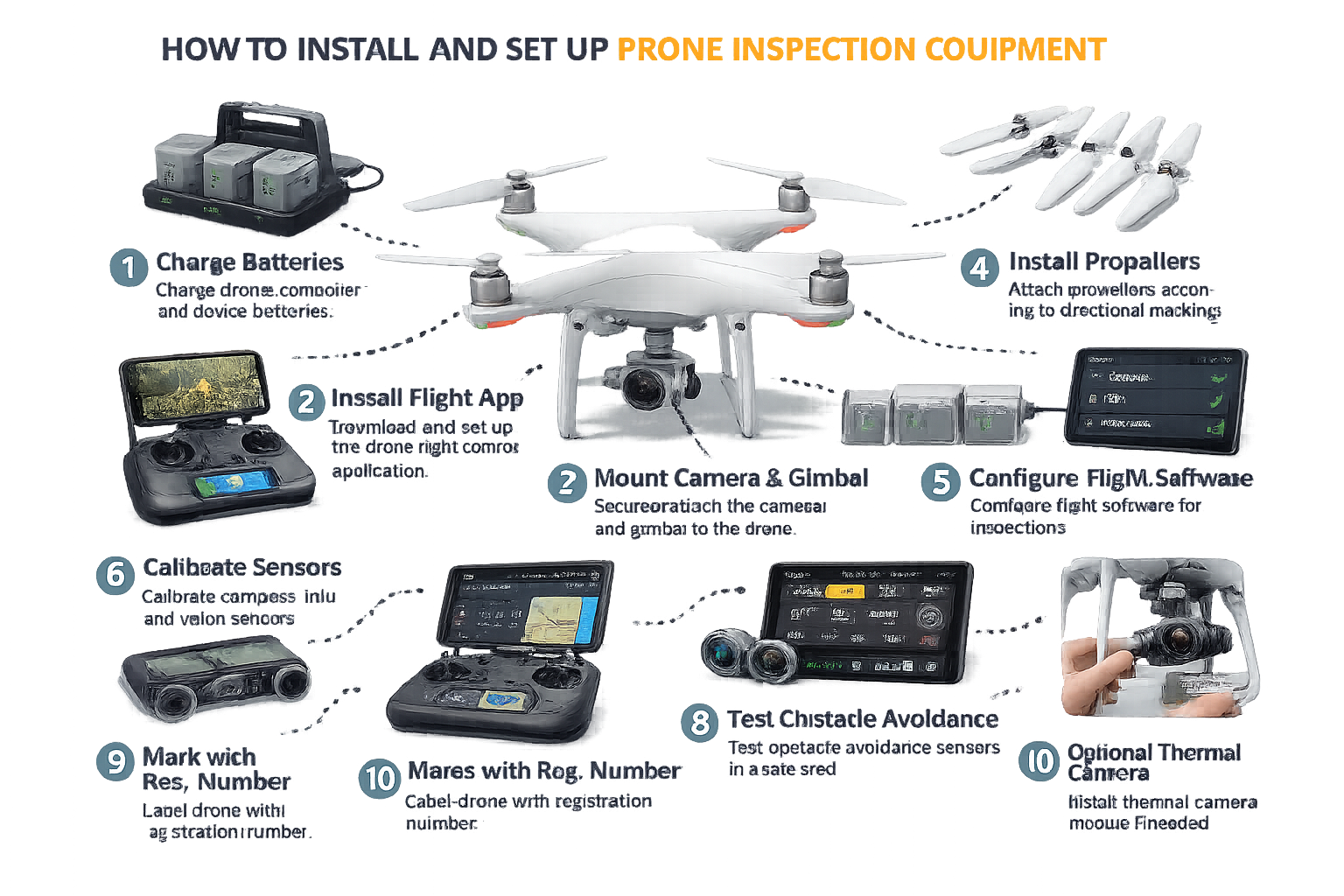
Properly installing and configuring equipment for drone roof inspection operations ensures optimal performance and data quality. Begin by fully charging all batteries for the drone, controller, and mobile device to prevent mid-flight power loss. Install the manufacturer’s flight control application on a compatible smartphone or tablet, ensuring the software version matches your drone model.
The setup process follows these essential steps:
Mount the camera and gimbal – Securely attach imaging equipment, ensuring all connections are tight and properly calibrated
Install propellers – Attach propellers according to directional markings, double-checking each is firmly secured
Configure flight software – Download and set up flight-planning applications like Hammer Missions or similar platforms
Calibrate sensors – Complete compass, IMU (Inertial Measurement Unit), and vision sensor calibrations per manufacturer instructions
Set camera parameters – Adjust resolution, exposure, white balance, and frame rate for optimal image capture
Test obstacle avoidance – Verify all sensors are functioning correctly before actual inspection flights
Register with aviation authorities – Complete FAA registration and mark the drone with the registration number
For thermal imaging capabilities, ensure the thermal camera module is properly mounted and software is configured to capture temperature variations that reveal insulation gaps or water intrusion. Before conducting paid drone roof inspection services, practice flights in safe locations help operators become familiar with equipment behavior and data capture settings.
How to Clean and Maintain Your Inspection Drone
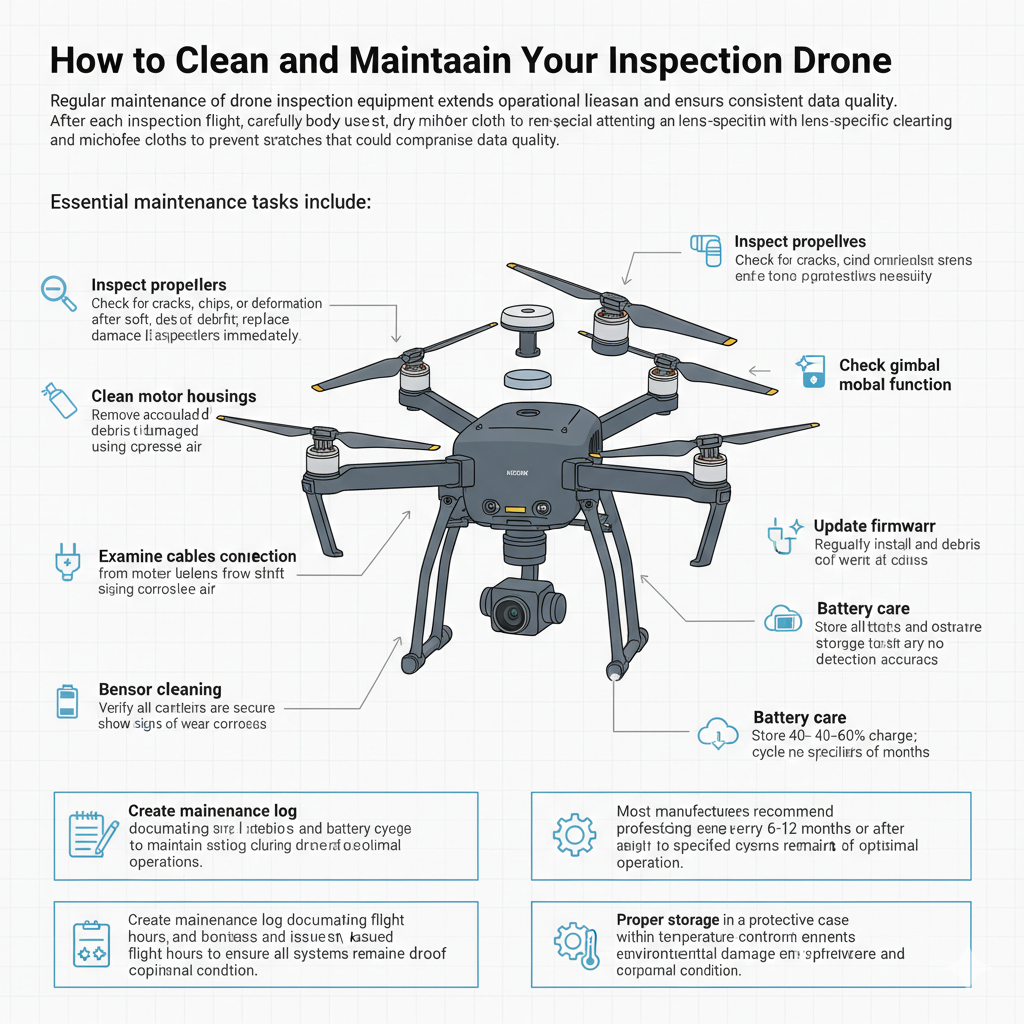
Regular maintenance of drone roof inspection equipment extends operational lifespan and ensures consistent data quality. After each inspection flight, carefully clean the drone body using a soft, dry microfiber cloth to remove dust, debris, and moisture. Pay special attention to camera lenses, cleaning them gently with lens-specific cleaning solutions and microfiber cloths to prevent scratches that could compromise image quality.
Essential maintenance tasks include:
Inspect propellers – Check for cracks, chips, or deformation after every flight; replace damaged propellers immediately
Clean motor housings – Remove accumulated dirt and debris from motor areas using compressed air
Check gimbal function – Test gimbal movement and stability; recalibrate if any drift or shakiness occurs
Examine cables and connectors – Verify all connections are secure and show no signs of wear or corrosion
Update firmware – Regularly install manufacturer software updates to maintain optimal performance and security
Battery care – Store batteries at 40-60% charge for long-term storage; cycle batteries every 3 months
Sensor cleaning – Carefully clean vision and obstacle avoidance sensors to maintain detection accuracy
Create a maintenance log documenting flight hours, battery cycles, and any issues encountered during drone roof inspection operations. Most manufacturers recommend professional servicing every 6-12 months or after a specified number of flight hours to ensure all systems remain in optimal condition. Proper storage in a protective case within temperature-controlled environments prevents environmental damage and premature component deterioration.
What Is the Cost of Starting a Drone Inspection Business
Launching a professional drone roof inspection business requires initial capital investment across equipment, licensing, insurance, and marketing. The primary expense is acquiring a quality commercial-grade drone, with professional models ranging from $1,000 for entry-level units to $5,000+ for advanced systems with thermal imaging capabilities. Beyond the aircraft itself, essential equipment includes spare batteries ($100-200 each), charging systems, protective cases, and backup propellers.
Startup cost breakdown includes:
FAA Part 107 certification – $175 for exam fee plus $150-300 for study materials
Drone and accessories – $1,000 to $5,000+ depending on capabilities
Liability insurance – $500 to $2,000 annually for commercial drone operations
Business licenses and permits – $50 to $500 depending on location
Software subscriptions – $300 to $1,200 annually for photogrammetry and reporting tools
Marketing and website – $500 to $2,000 for initial brand establishment
Transportation and storage – Vehicle equipment and secure storage solutions
Total initial investment for a drone roof inspection business typically ranges from $3,000 to $10,000. Additional ongoing costs include equipment maintenance, software renewals, continuing education, and marketing expenses. Developing a comprehensive business plan with clear pricing strategies that account for equipment costs, labor, insurance, and desired profit margins is essential for long-term sustainability.
Advantages of Drone Roof Inspection Technology
The benefits of drone roof inspection technology extend across safety, efficiency, cost-effectiveness, and data quality dimensions. The most significant advantage is eliminating the need for personnel to climb ladders or walk on potentially unstable roofs, dramatically reducing accident risks and liability exposure. Traditional roof inspections require scaffolding, harnesses, and multiple safety personnel, all of which are eliminated with aerial technology.
Key advantages include:
Enhanced safety – Removes fall hazards and reduces worker injury risks by keeping all personnel on the ground
Faster completion – Comprehensive roof scans completed in 15-30 minutes versus hours for manual inspections
Superior data quality – High-resolution imagery captures details invisible to ground-level observers
Cost reduction – Lower labor requirements and faster turnaround reduce overall inspection expenses
Comprehensive coverage – Drones access hard-to-reach areas like steep pitches, tall buildings, and dangerous locations
Minimal disruption – No need for building occupants to vacate or operations to cease during inspection
Digital documentation – Timestamped imagery creates verifiable records for insurance claims and maintenance tracking
Thermal capabilities – Advanced sensors detect hidden moisture, insulation deficiencies, and heat loss patterns
The transparency provided by detailed drone roof inspection reports builds trust between contractors and clients by offering visual evidence of roof conditions and recommended repairs. Additionally, year-over-year comparison of archived datasets enables proactive maintenance planning by tracking deterioration patterns over time.
Challenges and Limitations of Drone Roof Inspection
Despite numerous advantages, drone roof inspection technology faces several challenges and limitations that users must understand. The primary constraint is the inability to physically touch or feel roofing materials, making it impossible to assess firmness, detect moisture trapped under layers, or determine the resilience of shingles and tiles through tactile examination. Drones rely entirely on visual data, meaning underlying issues like rot beneath shingles, moisture in underlayment, or concealed structural damage remain undetectable.
Significant limitations include:
Weather dependency – Wind, rain, and extreme temperatures ground drone operations and delay inspections
Regulatory restrictions – Commercial operations require FAA certification and compliance with local airspace regulations
Equipment limitations – Battery life restricts flight duration, potentially requiring multiple sessions for large properties
Data interpretation requirements – Expert analysis is necessary to accurately assess captured imagery
Visual obstruction issues – Shadows, glare, or debris can obscure important details in captured imagery
Cannot detect subsurface problems – Hidden defects beneath visible layers remain unidentified
Limited close inspection – Intricate roof features and tight spaces may be difficult to examine closely
High initial investment – Quality equipment and training represent significant startup costs
Additionally, drone roof inspection cannot perform immediate repairs unlike traditional inspectors who identify and fix minor issues during their assessment. Some thermal imaging systems prove extremely costly while only highlighting specific problem types like leaks without detecting structural issues such as cracked tiles or loose masonry. For comprehensive roof assessment, many professionals recommend combining drone roof inspection with selective manual inspection of critical areas to overcome these limitations.
Special Topics: In-Depth Drone Roof Inspection Insights
How Drone Roof Inspections Work Tampa
Drone roof inspection services in Tampa, Florida have become increasingly popular due to the region’s harsh weather conditions and aging housing stock. Tampa’s extreme heat, heavy rainfall, and strong winds take significant tolls on roofing systems, making regular assessments essential for property preservation. Local providers offer specialized services tailored to Florida’s unique climate challenges, with many companies serving the entire Tampa Bay area using FAA-certified commercial drone pilots.
The Tampa drone roof inspection process typically begins with scheduling a consultation where operators assess property accessibility and identify specific concerns. During deployment, state-of-the-art drones equipped with 4K ultra-high-definition cameras capture detailed photographs from multiple angles, thermal imaging to detect moisture intrusion when necessary, and measurements with dimensional data. The entire flight operation takes 15-30 minutes depending on roof size and complexity, followed by comprehensive analysis and report generation.
Tampa-area services emphasize safety and non-invasive assessment methods, which particularly benefit the region’s significant senior population who appreciate thorough roof evaluations without the disruption of conventional inspections. High-resolution imagery enables accurate documentation for insurance claims following storm damage, a critical need in Florida’s hurricane-prone environment. Local drone roof inspection providers deliver detailed visual records invaluable for both immediate repair needs and long-term maintenance planning.
Drone Roof Inspection Cost
Understanding drone roof inspection cost structures helps property owners budget effectively and select appropriate service levels. Pricing models vary significantly based on geographical location, property characteristics, and service comprehensiveness. Most providers calculate fees using either square footage-based rates or hourly flight time charges, with some offering flat-rate packages for standard residential properties.
Detailed cost factors include:
Property size – Larger roofs require extended flight time and generate more data for analysis
Roof complexity – Multiple levels, steep pitches, and architectural features increase inspection difficulty
Inspection type – Basic visual surveys cost less than advanced thermal imaging assessments
Report detail – Comprehensive annotated reports with measurements command premium pricing
Location accessibility – Remote or restricted-access properties may incur travel surcharges
Urgency – Rush service requests typically add 20-50% to standard pricing
Standard residential drone roof inspection averages $150-$240 for 2,000 square foot properties, while commercial buildings range from $1,200 to $4,500+ depending on scale. Some companies offer no-cost inspections based on availability or when bundled with repair contracts, making it worthwhile to inquire about promotional offers. Insurance-related assessments often include additional documentation requirements that add $75-$200 to base inspection fees.
How to Start a Drone Roof Inspection Business
Launching a successful drone roof inspection business requires strategic planning across legal compliance, equipment acquisition, skill development, and marketing. The foundation begins with obtaining FAA Part 107 Remote Pilot Certification, which involves studying airspace regulations, weather theory, and emergency procedures before passing the written examination. This certification is legally mandatory for all commercial drone operations and demonstrates professional competency to potential clients.
Essential startup steps include:
Obtain necessary certifications – Complete FAA Part 107 exam and register business entity
Secure insurance coverage – Purchase commercial liability insurance protecting against property damage and injury claims
Invest in professional equipment – Acquire commercial-grade drone with high-resolution camera and backup batteries
Develop service offerings – Define inspection packages, pricing structures, and deliverable formats
Create business infrastructure – Establish legal entity, open business bank account, and implement accounting systems
Build portfolio – Conduct initial inspections for friends, family, or discounted clients to demonstrate capabilities
Implement marketing strategy – Develop website, establish social media presence, and network with roofing contractors
Establish partnerships – Connect with insurance companies, real estate agents, and construction firms for referral networks
Identifying target market segments such as residential homeowners, commercial property managers, insurance adjusters, or real estate professionals helps focus marketing efforts and tailor service offerings. Competitive pricing strategies should account for equipment costs, insurance premiums, labor time, and desired profit margins while remaining attractive relative to traditional inspection methods. Successful drone roof inspection businesses invest in continuing education to stay current with evolving technology, regulatory changes, and industry best practices.
How to Do a Roof Inspection with a Drone
Executing a professional drone roof inspection requires systematic methodology combining flight planning, data capture, and analytical assessment. The process begins with comprehensive pre-flight preparation including site assessment, weather evaluation, and equipment verification. Operators must check battery levels, confirm GPS signal strength, test camera functionality, and verify all control systems operate correctly before launching.
Step-by-step inspection procedure:
Conduct site survey – Walk the property perimeter identifying obstacles, power lines, and restricted zones
Program flight plan – Use software to trace building boundaries and configure altitude, overlap, and camera angles
Perform safety check – Verify all equipment connections, calibrate sensors, and confirm communication links
Execute automated flight – Launch drone to follow programmed grid pattern while monitoring for obstacles
Capture systematic imagery – Ensure comprehensive coverage with 75% image overlap for 3D reconstruction
Document critical areas – Take additional close-up shots of drainage points, joints, and visible wear zones
Apply thermal imaging – If applicable, capture temperature variation data revealing insulation gaps or moisture
Land and secure drone – Complete flight mission and safely store equipment
Post-flight processing involves importing captured images into photogrammetry software that analyzes GPS geotags and stitches photos into seamless orthomosaic maps and accurate 3D models. Inspectors systematically examine these digital outputs to identify damage such as cracked shingles, popped nails, rusted flashings, and gutter blockages, digitally tagging each issue with annotations. The final deliverable is a comprehensive report with annotated imagery, damage documentation, and recommended repairs that clients can use for maintenance planning or insurance claims. Professional drone roof inspection requires practice to master flight control, data capture techniques, and analytical assessment skills that distinguish quality services from amateur attempts.
Frequently Asked Questions : Drone roof inspection
What certifications are required to operate a drone for commercial roof inspections?
In the United States, commercial drone roof inspection operators must obtain an FAA Part 107 Remote Pilot Certificate by passing a written examination covering airspace regulations, weather theory, and emergency procedures. Additionally, the drone itself must be registered with the FAA. Some states and municipalities require additional business licenses and permits to operate commercially.
Can drones detect all types of roof damage?
While drone roof inspection excels at identifying visible surface damage like missing shingles, cracks, and deterioration, it cannot detect underlying issues such as rot beneath materials, trapped moisture in underlayment, or subsurface structural problems. Thermal imaging capabilities help reveal hidden moisture and insulation deficiencies, but comprehensive assessments often benefit from combining drone technology with selective manual inspection of critical areas.
How long does a typical drone roof inspection take?
The actual flight portion of a drone roof inspection typically takes 15-30 minutes depending on roof size and complexity. However, total project time includes pre-flight planning, data processing (which can take several hours), image analysis, and report generation. Most providers deliver completed inspection reports within 24-48 hours of the flight.
Is drone roof inspection cost-effective compared to traditional methods?
Drone roof inspection generally offers significant cost savings compared to traditional manual inspections by reducing labor requirements, eliminating expensive access equipment like scaffolding, and completing assessments much faster. For properties ranging from $150-$320, drone services typically cost less than manual inspections while providing superior documentation and safety benefits.
What weather conditions prevent drone roof inspections?
Drone roof inspection operations are grounded by strong winds (typically above 15-20 mph), rain, snow, extreme temperatures, and poor visibility conditions. Additionally, wet or icy roof surfaces can affect image quality and detection accuracy. Professional operators assess weather conditions before each flight and reschedule when conditions fall outside safe operational parameters.
Do I need special insurance for my drone inspection business?
Yes, commercial drone roof inspection businesses require specialized liability insurance covering property damage, personal injury, and equipment loss. Coverage typically costs $500-$2,000 annually depending on policy limits and business scope. Many clients, especially commercial property owners and insurance companies, require proof of adequate insurance before contracting services.
Conclusion
Drone roof inspection represents a transformative technology that revolutionizes how property assessments are conducted by delivering enhanced safety, superior efficiency, and comprehensive data quality. This aerial methodology eliminates dangerous ladder climbing while providing detailed high-resolution imagery that captures roof conditions from angles impossible with traditional approaches. From residential homeowners seeking routine maintenance to commercial property managers requiring large-scale assessments, drone roof inspection offers scalable solutions adaptable to diverse needs and budgets.
Other Resources
DJI Enterprise – Overview of drone solutions used for professional roof inspection and assessment.
Reddit – Drone Purchase for Roof Inspections – Community discussion about choosing drones suitable for roof inspection tasks.
DroneDeploy – Platform page explaining how drone software is used for roofing inspections and reporting.
Other Helpful Articles
Types of Roofs in Florida – Article outlining common roof types used in Florida and their characteristics.
Ventilation Systems for Flat Roofs – Guide describing ventilation options designed for flat roofing systems.
Checklist for Summer Roof Plumbing Middle Class Homes – Checklist covering seasonal roof and plumbing maintenance tasks.
Cost to Replace RV Roof – Article explaining factors that influence RV roof replacement costs.
