Roofing quotation: Vital Tips to Save Money
Roofing quotation: Vital Tips to Save Money
A home renovation project typically begins with excitement, but the financial reality sets in quickly, particularly when dealing with overhead protection. For homeowners, obtaining a precise roofing quotation is the most critical step in the journey toward a secure and watertight home. It acts as the financial blueprint for the entire project, outlining the scope of work, materials, and labor required. Without a detailed estimate, you leave yourself open to budget overruns and unexpected disputes with contractors.
Understanding the anatomy of a bid is not just about looking at the bottom line. It requires a deep dive into how professionals assess your property and determining what is necessary versus what is optional. This comprehensive guide will walk you through every aspect of the process, ensuring that the roofing quotation you sign is accurate, fair, and transparent.
Understanding How Costs Are Derived
When a contractor arrives at your property to prepare a roofing quotation, they are performing a complex calculation that involves much more than simply measuring the length and width of your house. The derivation of costs is a multi-layered process that begins with the concept of a “square.” In the roofing industry, a square equals 100 square feet of roof area. Contractors use this unit of measurement to determine the quantity of shingles, underlayment, and decking required.
However, the raw square footage is only the baseline. A professional must then factor in the “waste factor.” This accounts for materials that must be cut off and discarded to fit valleys, hips, and ridges. On a simple gable roof, the waste factor might be 10%, but on a complex roof with multiple dormers and intersecting planes, it can rise to 15% or even 20%. This calculation is essential for an accurate roofing quotation.
Furthermore, the derivation includes the tear-off costs. If your home has multiple layers of existing shingles, the labor required to remove them doubles or triples. Disposal fees, usually calculated by weight or dumpster volume, are also added at this stage.
Finally, the contractor assesses the ventilation system. A proper roofing quotation will always include calculations for intake vents (soffits) and exhaust vents (ridge vents or box vents) to ensure the roof meets building codes and manufacturer warranty requirements.
Major Factors Influencing the Final Price
Several variables can drastically alter the final number you see on a roofing quotation. Understanding these factors helps you realize why one neighbor might pay significantly less than another for a home of similar size.
-
Roof Pitch and Steepness: The slope of your roof is a primary cost driver. A steep roof is considered “non-walkable,” meaning the crew requires safety harnesses, scaffolding, and toe-boards to work safely. This slows down the installation process significantly, increasing labor hours and insurance risks, which inflates the roofing quotation.
-
Accessibility: If your home is surrounded by extensive landscaping, fences, or is located on a narrow street where a dump truck cannot get close, the crew must hand-carry materials. This manual labor adds time and cost.
-
Material Selection: The choice of material is the most obvious factor. Asphalt shingles are generally the most affordable, while metal, slate, or tile can cost three to five times as much. Even within asphalt, there is a price gap between standard 3-tab shingles and premium architectural shingles.
-
Complexity of the Roof Line: A roof with many chimneys, skylights, plumbing vents, and valleys requires intricate flashing work. Flashing is the metal used to seal joints and prevent water intrusion. This detail work is labor-intensive and requires skilled craftsmanship, which will be reflected in a higher roofing quotation.
Self-Estimation Before Calling Pros
Many homeowners wonder if they can estimate their own costs before receiving an official roofing quotation. While you cannot predict the exact price due to fluctuating material markets and labor rates, you can generate a ballpark figure to help you set a preliminary budget.
To do this, you must first calculate the footprint of your home and account for the slope and overhangs. There are online calculators that allow you to input your home’s ground dimensions and roof pitch to get an approximate square footage. Once you have the square footage, you can divide by 100 to get the number of “squares.”
Next, research the current price per square for your desired material in your local area. You can often find this information at big-box hardware stores, though contractor pricing may differ. Remember to add a buffer for labor, which usually accounts for 60% of the total project cost.
However, a self-made estimate will never replace a professional roofing quotation. You are likely to miss critical components like ice and water shield requirements, drip edge specifications, and local permit fees. Use your calculation as a baseline to determine if a contractor’s bid is wildly off-base, but rely on the professional’s numbers for the final contract.
Essential Inclusions in a Proposal
A professional roofing quotation should be a comprehensive document, not a number scribbled on the back of a business card. When you review the document, you must ensure that specific line items are present to protect your investment.
-
Scope of Work: A detailed description of exactly what will be done. This includes the removal of old materials, the inspection of the decking, and the installation of new components.
-
Material Specifications: The quote must list the specific brand, color, and style of the shingles, as well as the type of underlayment (felt vs. synthetic) and ventilation products.
-
Warranty Information: It should clearly distinguish between the manufacturer’s warranty on materials and the contractor’s workmanship warranty.
-
Timeline: An estimated start and completion date is crucial for planning.
-
Payment Terms: A legitimate roofing quotation outlines the deposit structure and final payment expectations. Never pay the full amount upfront.
If a contractor refuses to provide these details in writing, it is a significant red flag. The document protects both parties and ensures that there are no ambiguities regarding the quality of materials used.
Comparing Bids Effectively
Once you have gathered estimates from multiple companies, the challenge lies in comparing them. It is rarely an “apples to apples” comparison unless you scrutinize the details. One roofing quotation might be significantly lower because the contractor plans to re-use your existing flashing or install a lower grade of shingle.
To compare effectively, look at the “System Components.” Does Contractor A include a new drip edge while Contractor B does not? Does one quote include synthetic underlayment while the other uses standard tar paper? These differences affect the longevity of your roof.
You should also verify the licensing and insurance status included or referenced in the roofing quotation. A cheaper bid often comes from a contractor who cuts corners on liability insurance or workers’ compensation. If a worker is injured on your property and the contractor is uninsured, you could be liable. Therefore, a higher quote often reflects the overhead of running a legitimate, insured business.
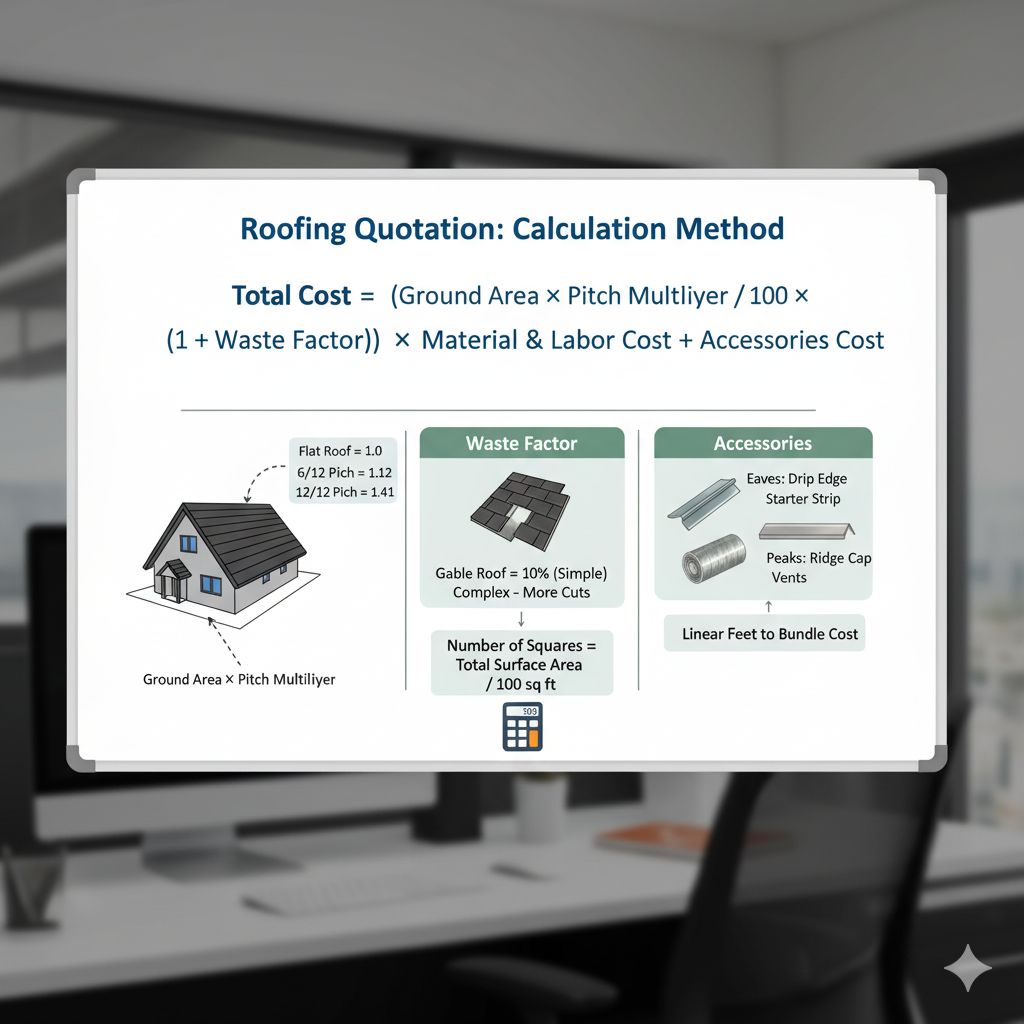
Roofing Quotation: Calculation Method
- The mathematical backbone of a roofing quotation relies on a formulaic approach that prioritizes surface area and complexity. The primary calculation method begins with the “Ground Area” of the building, which is then multiplied by a “Pitch Multiplier.” The Pitch Multiplier accounts for the extra surface area created by the slope of the roof. For example, a flat roof has a multiplier of 1, whereas a steep 12/12 pitch roof has a much higher multiplier because the rafter length is significantly longer than the horizontal run.
- Once the total surface area is determined, the estimator divides this figure by 100 to determine the number of squares. To this base number, they add the “Waste Factor.” The waste percentage is not arbitrary; it is calculated based on the type of roof. A gable roof typically incurs 10% waste, while a hip roof, which requires cutting shingles on all four sides, incurs 15% to 18% waste.
- Finally, linear footage measurements are taken for accessories. The estimator measures the total length of the eaves for drip edges and starter strips, and the length of the peaks for ridge caps and vents. These linear measurements are converted into bundle costs and added to the total roofing quotation.
Roofing Quotation: Numerical Example
Imagine a home with a ground footprint of 2,000 square feet. The roof has a moderate pitch (6/12), which carries a pitch multiplier of approximately 1.12.
-
Calculate Actual Roof Area:
2,000 sq ft (footprint) × 1.12 (multiplier) = 2,240 sq ft. -
Convert to Squares:
2,240 ÷ 100 = 22.4 squares. -
Apply Waste Factor:
Assuming a standard gable roof, we apply 10% waste.
22.4 squares × 1.10 = 24.64 squares.
Contractors round up to the nearest bundle, so the roofing quotation will list 25 squares of material. -
Cost Application:
If the contractor charges $450 per square (including labor, material, and disposal):
25 squares × $450 = $11,250.
This $11,250 figure becomes the baseline for the roofing quotation. However, this does not include permit fees ($200) or plywood replacement ($80 per sheet for damaged decking discovered during tear-off). Therefore, the homeowner should anticipate the final cost to be closer to $12,000 based on this numerical example.
Roofing Quotation: Simple Calculation Tips
If you cannot access the roof to measure, use the “Floor Plan Method.” Take the total square footage of your home’s upper floor (including the garage if attached). Multiply this number by 1.35. This generally accounts for a standard pitch and a moderate overhang. While not perfect, it gives you a safe “high-end” number for squares to use in your preliminary roofing quotation research.
Another tip is to count the shingle tabs on the eaves if you can see them clearly. Standard 3-tab shingles are usually 12 inches wide. By counting the tabs along the length of the house, you can determine the linear footage without a tape measure.
Always assume the worst regarding plywood decking. When creating your own mental budget, add 10% to whatever total you calculate to account for “unforeseen conditions.” This financial buffer ensures that when the official roofing quotation arrives, you are not shocked by contingency costs for rotting wood.
Roofing Quotation: Finding Estimates and Roofing Companies
Finding a trustworthy company to provide a roofing quotation requires diligence. Start by soliciting recommendations from local hardware supply stores. These suppliers know which contractors pay their bills on time and buy quality materials.
utilize digital platforms like Google Reviews and the Better Business Bureau, but treat them with caution. Look for patterns in reviews rather than isolated complaints. When you contact a company, pay attention to their responsiveness. If they are slow to schedule an appointment for a roofing quotation, they will likely be slow to finish the job.
Request at least three estimates. This “Rule of Three” allows you to identify outliers—if one bid is suspiciously low or exorbitantly high, you can discard it. Ensure every company you contact is local to your area. “Storm chasers”—companies that travel to areas recently hit by hail—often provide a quick roofing quotation but may not be around to honor the warranty six months later.
Advantages of Getting Multiple Bids
Securing multiple options is the smartest strategy a homeowner can employ. The primary advantage is leverage. When a contractor knows you are soliciting other bids, they are more likely to offer their most competitive pricing upfront. It also prevents price gouging. Without a second or third roofing quotation to compare against, you have no way of knowing if the price per square is consistent with current market rates.
Moreover, meeting multiple contractors allows you to gauge professionalism. The way a contractor presents their roofing quotation—whether it is a digital file with photos or a handwritten note—speaks volumes about their organization. You can ask each contractor the same questions and compare their answers. If two contractors say your chimney flashing needs replacement and the third says it is fine, you can reasonably assume the third contractor might be cutting corners to lower their price.
Multiple bids also expose you to different product options. One contractor might specialize in a specific brand of shingles that offers better wind resistance, a detail you might miss if you only obtain a single roofing quotation.
Common Challenges in the Process
Despite your best efforts, the process of obtaining and finalizing a roofing quotation comes with inherent challenges. Volatility in material prices is a major issue. In recent years, the cost of asphalt and lumber has fluctuated wildly. A quote you receive today might only be valid for 15 or 30 days. If you wait too long to sign, the contractor may need to issue a revised quote with higher prices.
Another challenge is the “unforeseen damage” clause. No roofing quotation can 100% guarantee the final price because the contractor cannot see underneath your existing shingles until they are removed. If the decking is rotten or the rafters are cracked, these repairs will be billed as “change orders” or supplemental charges. This often leads to friction between homeowners and contractors if not explained clearly beforehand.
Finally, deciphering technical jargon can be difficult. Terms like “ice damming,” “step flashing,” and “ridge vent baffle” can be confusing. It is the homeowner’s responsibility to ask for clarification to ensure they fully understand what is included in the roofing quotation.
FAQ : Roofing quotation
Is a roofing quotation usually free?
Yes, the vast majority of reputable residential roofing contractors offer free estimates. Be wary of companies that ask for a payment just to provide a quote, as this is not standard industry practice.
How long is a roofing quotation valid for?
Typically, a quote is valid for 30 days. Due to the fluctuating cost of petroleum (which affects asphalt shingles) and lumber, contractors cannot guarantee pricing for extended periods.
Does the roofing quotation include the cost of permits?
It should, but you must verify this. A professional quote will list “permits and inspections” as a line item. If it is not listed, ask the contractor if you are expected to handle the permitting process yourself.
What happens if the contractor finds rot after providing the roofing quotation?
This is handled via a “change order” or a “per-sheet rate” listed in the contract. Most quotes will include a price per sheet for plywood replacement (e.g., $75 per sheet) to cover this possibility transparently.
Can I negotiate the price on a roofing quotation?
Yes, there is often some room for negotiation, especially regarding the timing of the work or the specific materials used. However, be careful not to negotiate so aggressively that the contractor compromises on quality labor to meet your price.
Conclusion
Navigating the complexities of a roof replacement starts with the document that governs the entire project: the roofing quotation. It is more than just a price tag; it is a detailed proposal that outlines the health of your home’s structure, the quality of materials to be installed, and the integrity of the company you are hiring. By understanding how these costs are calculated, recognizing the factors that influence the total, and knowing how to compare different proposals effectively, you empower yourself to make a wise investment.
Remember that the cheapest option is rarely the best in the construction industry. A low roofing quotation often signals missing components, uninsured labor, or inferior materials that will fail prematurely. Conversely, a fair and detailed estimate ensures that your home is protected by a system designed to last for decades. Take the time to analyze the numbers, ask the hard questions, and choose a partner who values transparency as much as craftsmanship.
🔧 Other Resources
• Roofing Calculator – Online tool providing roofing cost estimates based on project size and material inputs.
• Roofing Quote USA – Web-based service offering roofing quote requests and price comparison options.
• Roofr – Informational blog article explaining how to structure clear and organized roofing quotes.
• SumoQuote – Digital platform designed to create, manage, and standardize professional roofing quotes.
🔎 Other Helpful Articles
• Wind Damage Roof – Informational article explaining common causes and effects of wind damage on roofs.
• Elastomeric Roof Coating – Educational overview describing elastomeric roof coatings and their typical uses.
• Emergency Roof Repair – Informational guide outlining emergency roof repair situations and response steps.