
Snow Guards for Slate Roofs: Best Systems
Snow Guards for Slate Roofs: Best Systems
Winter weather brings a specific beauty to architectural structures, particularly those adorned with natural stone. However, that beauty comes with significant risks if not managed properly. When heavy precipitation accumulates, the smooth surface of stone tiles can create a dangerous slide for ice sheets. This is why snow guards for slate roofs are an absolute necessity for homeowners in colder climates. These devices are not merely decorative; they are critical safety components designed to hold precipitation in place, allowing it to melt gradually rather than crashing down in a destructive avalanche. Without them, the sheer weight of falling ice can damage gutters, landscaping, vehicles, and even pose a threat to pedestrians below.
Understanding the mechanics of these devices is the first step toward protecting your property. A slate roof is significantly more slippery than asphalt shingles. Once a layer of ice forms between the slate and the snow pack, friction is lost almost entirely. Snow guards for slate roofs act as friction points, breaking up the continuous surface area. By disrupting the slide, they distribute the weight of the accumulation across the roof structure rather than allowing it to concentrate at the eaves. This distribution is vital for maintaining the structural integrity of the roof deck and preventing sudden, catastrophic shedding events.
Choosing the right system involves navigating a complex market of materials and designs. From traditional pad styles to modern pipe systems, the options can be overwhelming. Each type serves a specific function and aesthetic purpose. For historic homes, maintaining architectural integrity is often as important as functionality. Fortunately, modern engineering has provided solutions that blend seamlessly with vintage aesthetics while offering superior holding power. Whether you are retrofitting an existing structure or planning a new build, understanding how snow guards for slate roofs function will ensure you make an educated investment in your home’s longevity.
What Is a Snow Retention System?
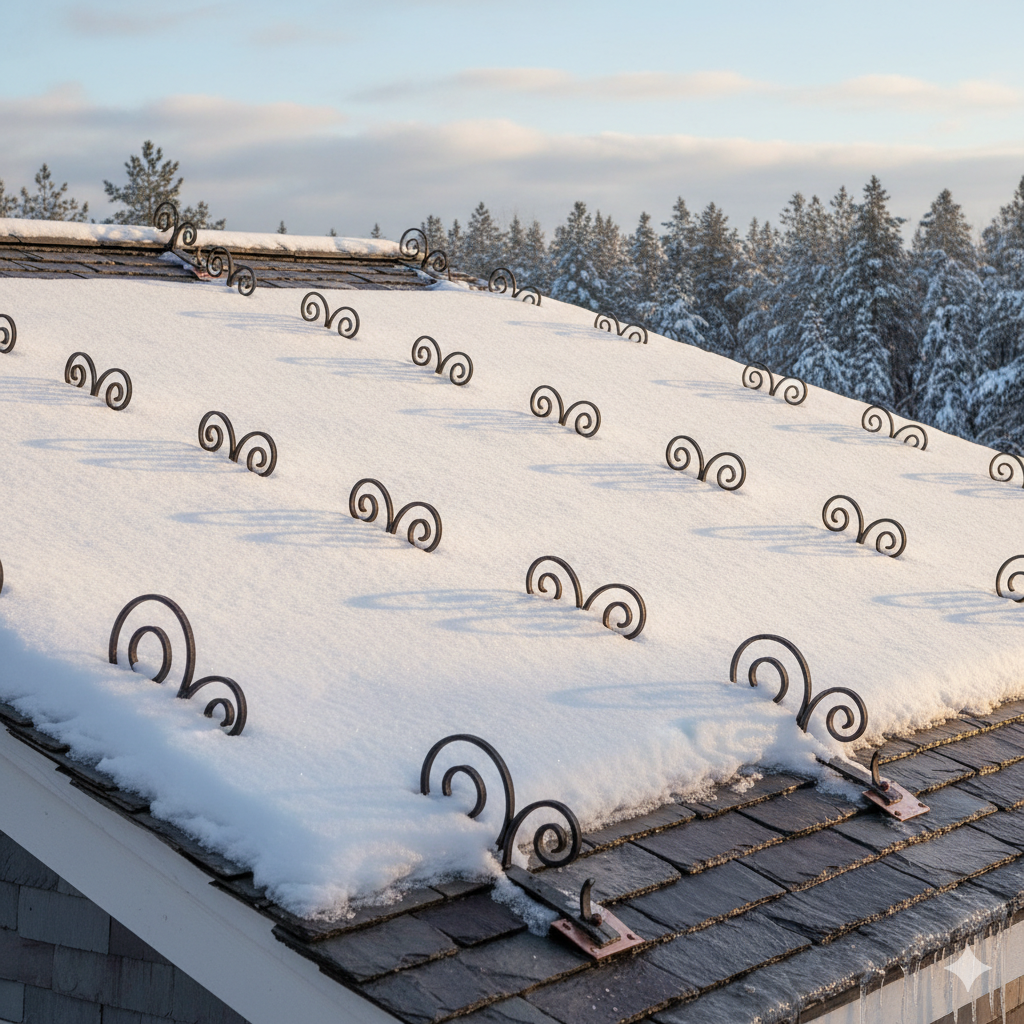
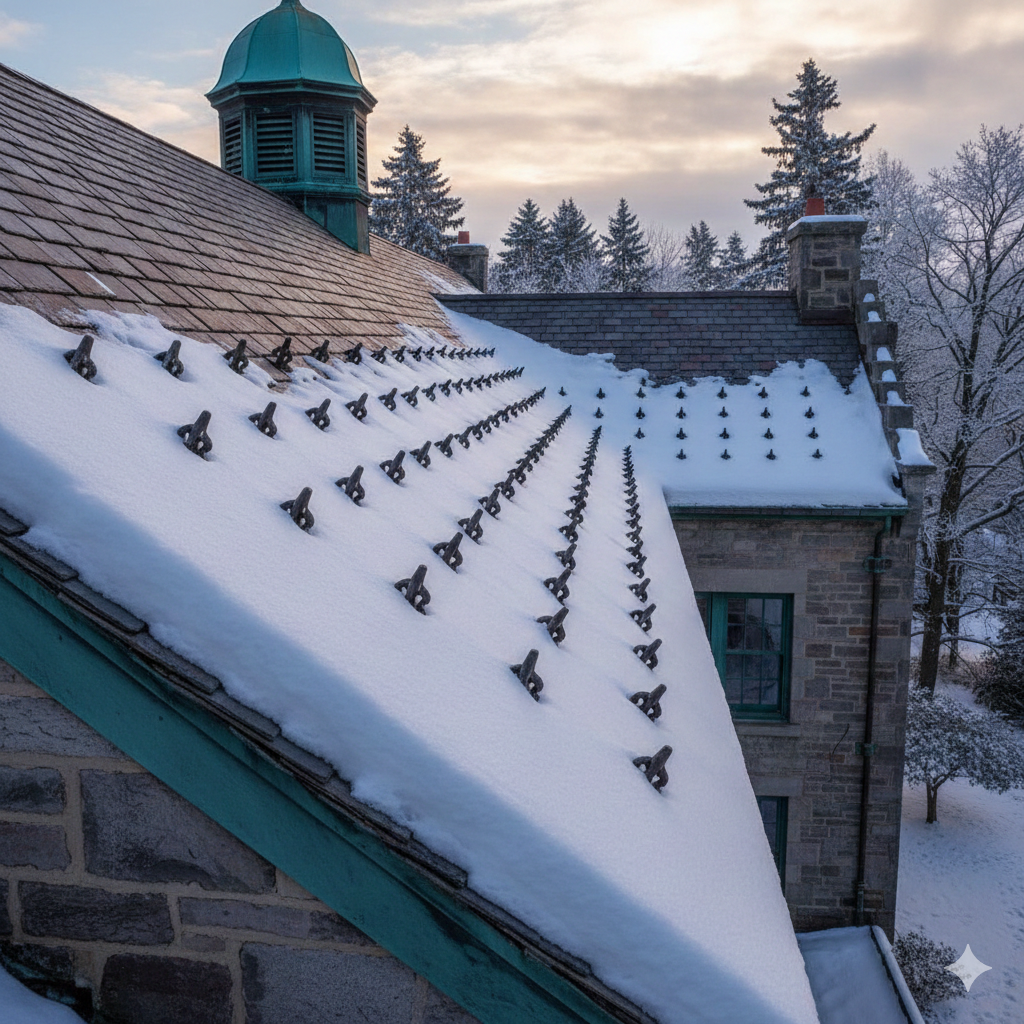
At its core, a snow retention system is a series of obstacles installed on a roof to prevent the sudden movement of frozen precipitation. On slate specifically, the need is amplified due to the material’s low coefficient of friction. Snow guards for slate roofs function by increasing friction and holding the snow pack on the roof surface. This retention allows the snow to melt off gradually as water or drop off in small, harmless amounts. There are two primary categories: pad-style guards and pipe-style guards. Pad-style guards are individual units arranged in a staggered pattern, while pipe styles involve horizontal bars running parallel to the eaves.
The engineering behind these devices is deceptively simple but highly effective. By suspending the snow field, the guards transfer the vector force of the snow load into the roof deck and building structure. This prevents the “avalanche effect” commonly seen on unguarded smooth roofs. When selecting snow guards for slate roofs, it is crucial to understand that they are designed to fail if overwhelmed by a load exceeding the roof’s structural capacity, which is actually a safety feature to prevent roof collapse. However, properly calculated systems rarely reach this point in typical weather conditions.
Materials matter significantly in this application. Because slate is a premium, long-lasting material (often lasting 100 years or more), the accessories attached to it must have a similar lifespan. This is why you will frequently see copper, bronze, and stainless steel used for snow guards for slate roofs. Using a metal that corrodes quickly, like galvanized steel without proper coating, would result in the guards failing long before the roof does, leading to difficult and expensive repairs. The goal is to install a system that ages gracefully alongside the stone.
How to Find the Right Model
Finding the correct model requires an assessment of your specific roof geometry and local climate data. Not all roofs need the same level of protection. A steep pitch in a high-snowfall area requires a robust pipe system, whereas a lower pitch in a moderate climate might only need pad-style snow guards for slate roofs. Start by consulting with a roofing professional who specializes in slate. General contractors often lack the nuanced knowledge required for natural stone roofing and may recommend products that are incompatible or damaging to the slate tiles.
You can also look for manufacturers who offer engineering layouts. Reputable suppliers of snow guards for slate roofs will often provide a calculation service. You provide them with the roof pitch, rafter length, sheath material, and local ground snow load, and they calculate exactly how many rows of guards you need and at what spacing. This scientific approach eliminates guesswork. Searching online forums dedicated to historic home preservation can also yield recommendations for specific brands that have stood the test of time on similar architectural styles.
When browsing options, pay close attention to the attachment method. For existing roofs, you need retrofit guards that slide under the slate and hook onto the nail or use a strap method. For new roofs, the guards are installed as the slate is laid. Finding snow guards for slate roofs that match your installation phase is critical. Do not attempt to use glue-on guards for natural slate; the surface often flakes or creates dust, rendering adhesives unreliable over the long term. Mechanical attachment is the only secure method for finding peace of mind.
How to Buy Quality Guards
Buying these components is an investment in quality assurance. Avoid big-box hardware stores, which rarely stock the specialized snow guards for slate roofs required for proper installation. Instead, focus your purchasing efforts on specialized roofing supply houses or direct-from-manufacturer orders. Many high-end manufacturers sell directly to homeowners or through authorized distributors who understand the technical specifications of the product. When you buy, ensure you are getting the necessary hardware, such as longer nails or hooks, if they are not included in the main package.
Verify the warranty information before finalizing your purchase. High-quality snow guards for slate roofs should come with a warranty against material defects. Since these items are exposed to the harshest elements—freeze-thaw cycles, UV radiation, and heavy loads—the material quality is non-negotiable. If you are buying copper guards, ask about the gauge and temper of the metal. If buying cast bronze, check for casting quality. The buying process should involve a conversation about “service life.” If the vendor cannot answer how long the guards will last, look elsewhere.
It is also wise to buy a few extra units. During installation, it is not uncommon to drop a piece or discover that the spacing needs to be tightened slightly in valley areas. Having a surplus of snow guards for slate roofs ensures the project continues without delay. Additionally, check the return policy. If you order a style that visually clashes with your home’s aesthetic once you see it in person, you want the option to exchange it for a different design. Aesthetics play a large role in slate roofing, and the hardware should complement, not detract from, the beauty of the stone.
How Much Do They Cost?
The cost of these systems varies wildly depending on material and design complexity. Basic stainless steel or coated aluminum pad-style snow guards for slate roofs can range from $15 to $25 per piece. While this might sound inexpensive, remember that you may need hundreds of them for a large roof. A standard pattern might require one guard every 18 to 24 inches horizontally and every few courses vertically. This creates a grid that can quickly add up in material costs alone.
Moving up the luxury ladder, cast bronze or fabricated copper snow guards for slate roofs command a premium price. These can range from $40 to over $80 per unit. While the upfront cost is higher, these materials are chosen for their longevity. A slate roof is a 100-year system; installing cheap guards that rust out in 20 years makes no financial sense because the labor to replace them is exorbitant. Pipe-style systems are priced differently, usually by the linear foot. A dual-pipe copper system can cost between $50 and $100 per linear foot, including brackets and tubing.
Labor is the other half of the equation. Installing snow guards for slate roofs is labor-intensive, especially for retrofits. The roofer must carefully lift existing slates without breaking them, insert the guard, and secure it. This requires skilled labor, which comes at a premium. Expect labor costs to potentially double the material cost. While the total investment is significant, it must be weighed against the potential cost of property damage. A collapsed gutter, a smashed car windshield, or a personal injury lawsuit caused by falling ice will far exceed the price of a proper snow retention system.
How to Install on New vs. Existing Roofs
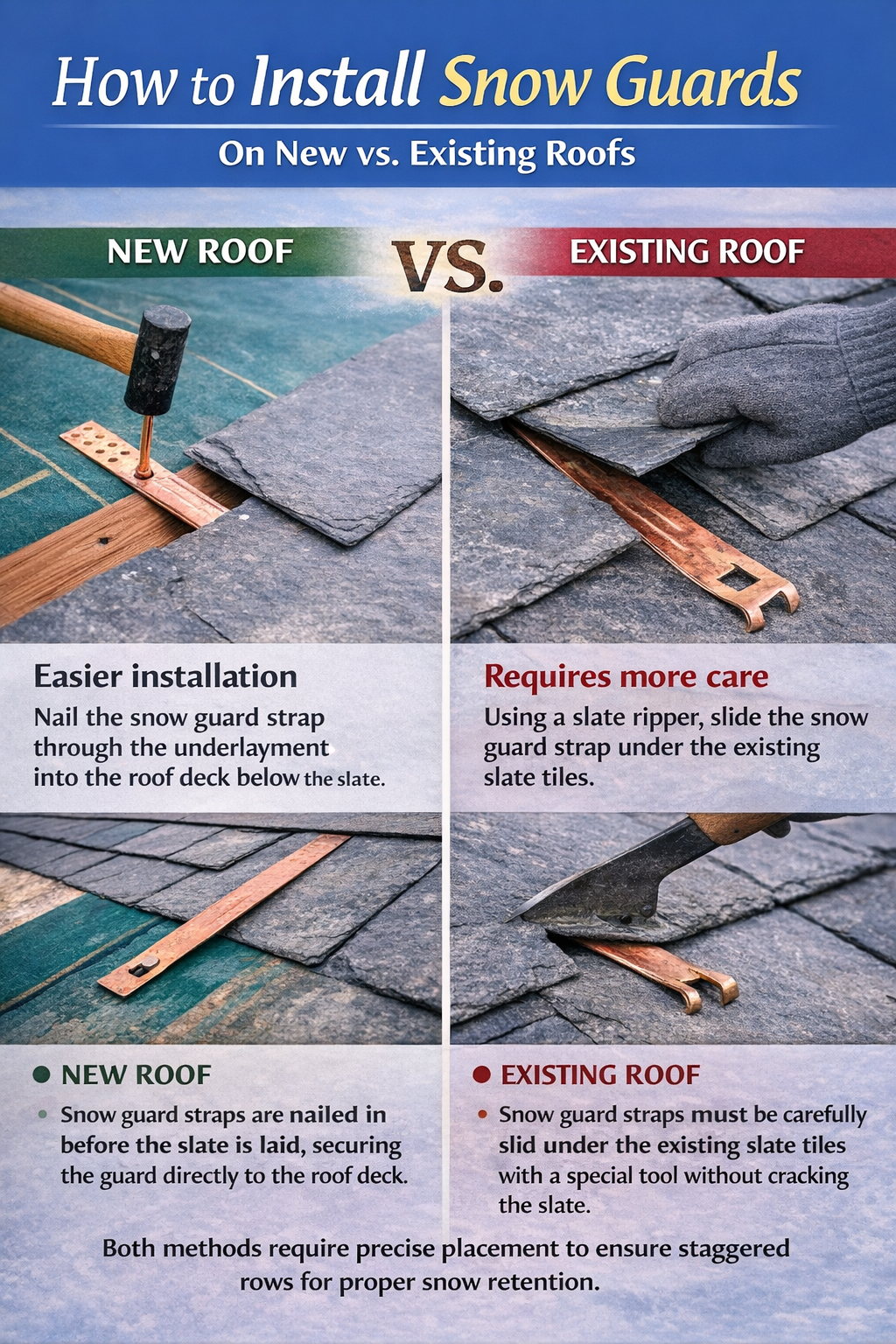
Installation methodology differs significantly based on whether the roof is currently being installed or if it is already in place. For new construction, installing snow guards for slate roofs is streamlined. The roofer integrates the guard directly into the layout. The strap or bracket is nailed into the roof deck before the overlying slate is placed. This provides the strongest possible connection because the fasteners are covered and the load is transferred directly to the sheathing. The layout is calculated beforehand, ensuring perfect symmetry and load distribution.
Retrofitting requires much more finesse. To install snow guards for slate roofs on an existing structure, the installer must use a “slate ripper” or a specialized hook tool to loosen the slate above the target location. The guard’s strap is then slid underneath the slate. Ideally, it hooks onto the nail head holding the slate, or a hook is driven into the sheathing between the slates. Great care must be taken not to crack the brittle stone tiles during this process. A “retrofit” style guard is specifically designed with a hook or a strap configuration that accommodates this blind installation method.
1. Assessment: Determine the rafter length and pitch to calculate row spacing.
2. Layout: Mark the locations with chalk (or mentally) to ensure a staggered pattern.
3. Loosening: Gently lift the slate where the guard will reside.
4. Insertion: Slide the strap of the **snow guards for slate roofs** up under the slate until it engages the nail or hanger.
5. Setting: Pull down to ensure the hook is set securely.
6. Verification: Check that the guard sits flush and the overlying slate is not cocked or stressed.
Correct torque and tension are vital for pipe systems. When installing pipe-style snow guards for slate roofs, the brackets are usually bolted through the slate into the rafters or deck. This requires drilling through the slate, which carries a high risk of breakage. Rubber gaskets and flashing are essential to seal these penetrations. Professional installation is highly recommended for pipe systems to prevent leaks.
Specialized Systems: Copper and Heavy Duty Options
When dealing with premium roofing, specific materials and configurations stand out. Here, we delve into four distinct categories that homeowners often encounter when researching protection for their slate homes.
1: Copper Snow Guards for Slate Roofs
Copper is the gold standard for slate roofing accessories. It is chosen not just for its appearance, which patinas from a bright penny color to a distinguished verdigris green, but for its chemical compatibility. Copper snow guards for slate roofs will not react negatively with the stone or the nails, provided copper or stainless nails are used. They are incredibly durable and malleable enough to handle the expansion and contraction cycles of the roof without cracking.
2: Slate Roof Snow Guard
The singular term often refers to the specific unit design. A high-quality slate roof snow guard typically features a wide strap and a decorative casting or fabricated bent metal face. The “face” is the part that actually stops the snow. The height of this face is critical; it must be high enough to engage the snow blanket but not so high that the torque acts as a lever, ripping the guard out.
3: Roof Snow and Ice Guard Systems for Slate Roofs
This terminology usually refers to comprehensive solutions that combine multiple technologies. Integrated roof snow and ice guard systems for slate roofs might employ heating cables alongside mechanical guards. The guards hold the snow in place, while the heating elements create melt channels to prevent ice dams. This dual approach is essential for commercial buildings or homes with complex valleys where ice accumulation is severe.
4: Roof Snow Guard Systems for Slate Roofs
When we discuss full roof snow guard systems for slate roofs, we are talking about the engineering layout. It’s not just about one row at the bottom. Effective systems often require three, four, or even more rows distributed up the slope of the roof. This “tiering” is crucial because it reduces the load on any single row. If you only install one row at the eaves, the weight of the entire roof’s snow load rests on that single point, often leading to failure.
Advantages and Challenges
The primary advantage of installing snow guards for slate roofs is safety. They prevent heavy, dangerous loads from falling on people and property. Secondly, they protect the roof itself. When a massive sheet of ice slides, it acts like a scouring pad, scratching the slate and potentially ripping out gutters and fascia boards. By keeping the snow in place, you extend the lifespan of your gutter system and reduce maintenance costs on perimeter landscaping that would otherwise be crushed.
However, challenges exist. The most significant challenge is the cost. Snow guards for slate roofs represent a substantial financial outlay. Additionally, improper installation can cause leaks. If a retrofit guard is forced in and cracks a slate, water can infiltrate the home. Another challenge is aesthetics; some homeowners dislike the look of “clutter” on their clean roof lines. This is subjective, but it is a valid concern for those adhering to strict architectural minimalism.
Another challenge involves “buckling.” If the snow guards for slate roofs are spaced too far apart, the snow mass can snake between them or buckle in the middle. This creates uneven loading and can twist the guards. This highlights the importance of using a calculated density calculation rather than just guessing the spacing. Furthermore, organic debris like leaves and pine needles can get caught behind the guards, requiring occasional cleaning to prevent moisture retention against the slate.
How to Clean and Maintain
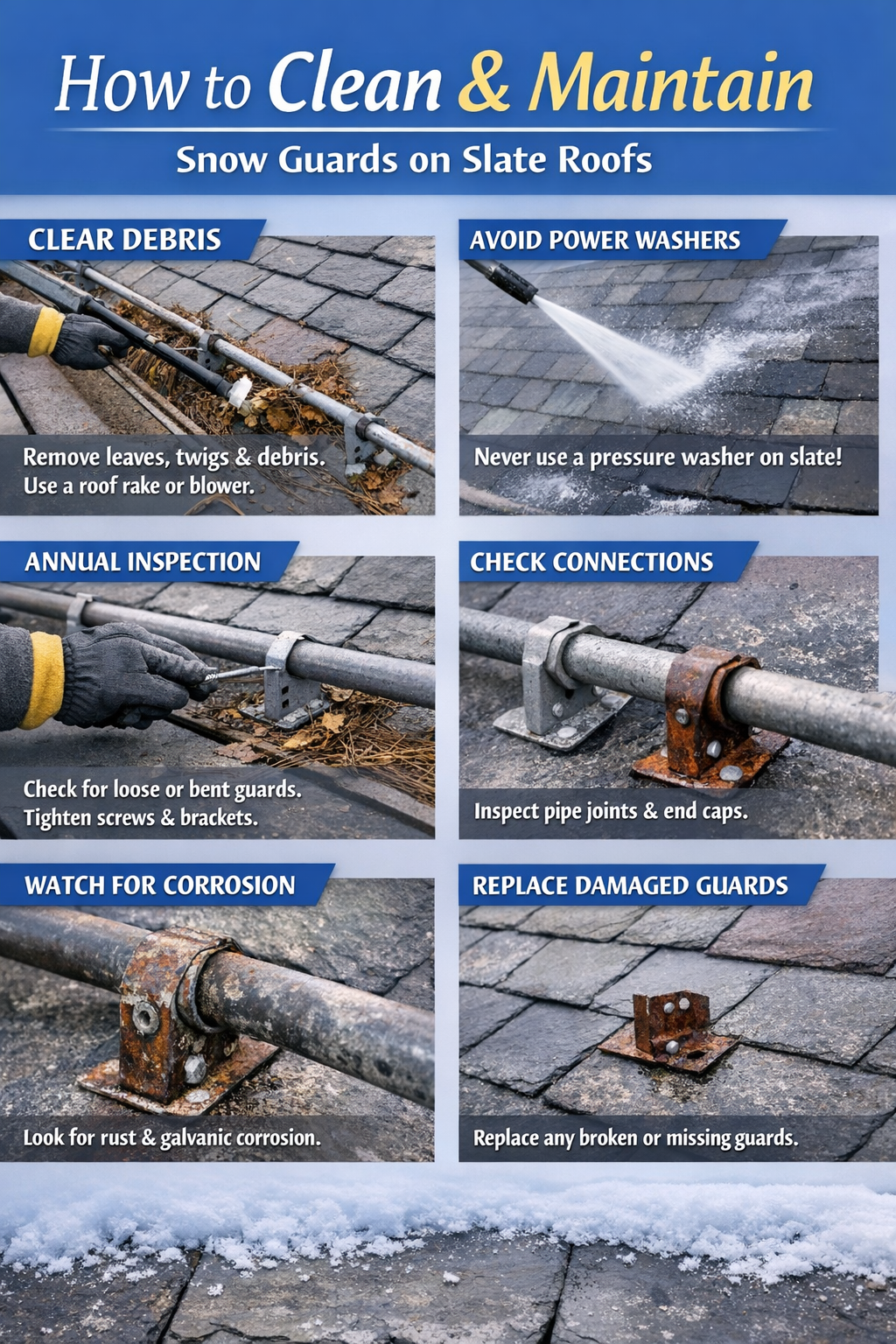
Maintenance of these systems is relatively low, but not non-existent. The most common issue with snow guards for slate roofs is the accumulation of debris. Leaves, twigs, and pine needles can catch on the uprights or tubes. This debris retains moisture, which can accelerate biological growth like moss or lichen on the slate. Cleaning should be done carefully using a roof rake from the ground if possible, or by a professional with a blower. Never use a high-pressure power washer on a slate roof, as it can damage the stone.
Inspect the guards annually, preferably in the autumn before the first snow. Look for any bent or loose units. If you have pipe-style snow guards for slate roofs, check the connections where the pipes join and the end caps. Expansion and contraction can sometimes work these loose. Tighten any set screws and ensure the brackets are still firmly seated against the roof deck. If you notice a guard has been ripped out, it must be replaced immediately to maintain the integrity of the system.
Check for corrosion. While copper and stainless steel are resistant, they are not immune to environmental pollutants. If you see signs of galvanic corrosion—where two dissimilar metals are reacting—you may need to intervene. For example, if an aluminum clip was used on a copper system (a major error), it will degrade rapidly. Keeping your snow guards for slate roofs clean and mechanically sound ensures they will be ready to perform when the next blizzard hits.
What Is the Cost of Failure?
Skipping the installation of snow guards for slate roofs is a gamble with high stakes. The financial cost of failure often exceeds the price of the system. The most immediate cost is gutter replacement. A sliding ice sheet can shear off aluminum or copper gutters instantly, costing thousands in repairs. Beyond gutters, the impact on lower roof sections can be devastating. If an upper roof sheds onto a lower roof (like a porch), the impact can shatter the slate on the lower level, leading to complex and expensive repairs.
Liability is the silent cost. If a delivery driver, guest, or family member is struck by falling ice because you lacked snow guards for slate roofs, the medical and legal costs can be astronomical. Homeowner’s insurance may cover the damages, but premiums will likely rise, or coverage could be dropped if negligence is determined. In commercial settings, code compliance often mandates snow retention over entryways, making the absence of guards a legal violation.
There is also the cost of landscape destruction. Expensive ornamental shrubs and trees planted near the foundation are easily crushed by roof avalanches. Over time, the repeated impact of falling snow can damage the foundation grading, leading to basement water issues. Investing in snow guards for slate roofs is essentially an insurance policy for the entire perimeter of your home, protecting everything from the foundation up to the eaves.
How to Install: Step-by-Step Overview
While professional installation is recommended, understanding the process helps in supervising the work. The layout is the first critical step. The installer should snap chalk lines to ensure the snow guards for slate roofs are straight and level. For pad guards, a “W” pattern or staggered grid is standard. This ensures that snow sliding between two guards in the first row is caught by a guard in the second row.
1. Preparation: Ensure the roof deck is sound. Rotting wood cannot hold the load.
2. Tooling: Use a slate ripper to expose the hidden nail head of the slate.
3. Positioning: Place the **snow guards for slate roofs** strap flat against the underlayment.
4. Hooking: Engage the nail or drive a new fastener if the system design allows.
5. Restoration: Slide the slate back into position. It should lay flat. If the guard strap is too thick, it may cause the slate to “kick up,” which is undesirable.
6. Repetition: Repeat this hundreds of times across the roof surface according to the engineered diagram.
For pipe systems, the brackets are installed at intervals (usually every 24 to 48 inches). The pipes are then threaded through the holes in the brackets. Collars or couplers are used to join pipe lengths. End caps are installed to prevent moisture from entering the tubes and freezing, which could split the pipe. The entire assembly of snow guards for slate roofs must be checked for rigidity before the job is considered complete.
FAQs : snow guards for slate roofs
Do snow guards cause ice dams?
No, snow guards for slate roofs do not cause ice dams. Ice dams are caused by heat loss from the attic melting the snow, which then refreezes at the eaves. Guards hold the snow, but they do not influence the thermal dynamics of the roof deck. However, by holding snow on the roof, they may hide an existing insulation problem.
Can I install these myself?
It is highly discouraged. Slate is brittle and slippery. Walking on it requires specific footwear and knowledge of where to step (on the head of the slate, not the middle). Attempting to install snow guards for slate roofs without experience often results in more broken slate tiles than successful installations, not to mention the extreme safety risk of working at heights.
Do I need guards on the entire roof?
Not necessarily. You absolutely need snow guards for slate roofs over entryways, walkways, garage doors, and expensive landscaping. However, many homeowners choose to protect the entire perimeter to preserve gutters and ensure uniform snow shedding. Partial installation is common and effective for targeted protection.
Will the guards rust my slate?
Only if you choose the wrong material. Using mild steel or low-grade galvanized iron will eventually lead to rust streaks that stain the stone. Always choose copper, stainless steel, or bronze snow guards for slate roofs to prevent unsightly staining that is nearly impossible to remove from porous stone.
Conclusion
In the realm of roofing, the marriage of function and form is nowhere more critical than on a slate roof. These historic and durable structures deserve the best protection available. Snow guards for slate roofs are not an optional accessory for those living in snow-prone regions; they are a fundamental component of the roofing system. They manage the heavy, dangerous loads of winter precipitation, transforming a potential hazard into a managed element of the season.
By increasing friction and distributing weight, these devices preserve the structural integrity of the building and ensure the safety of those around it. Whether you opt for the discrete elegance of copper pads or the robust industrial look of pipe systems, the key is quality and proper engineering. Cheap materials and poor layouts will ultimately fail, leading to greater costs down the road. Investing in high-quality snow guards for slate roofs is an investment in the legacy of the home itself.
From the initial calculation of snow loads to the final installation of the last bracket, every step matters. As you prepare your home for the winter months, look up at your eaves. If they are bare, consider the risks. The addition of snow guards for slate roofs brings peace of mind, knowing that when the snow falls, your home is prepared to handle the weight with grace and strength. Secure your investment, protect your family, and preserve the beauty of your slate roof with the right retention system.
Other Resources
Slate Roof Warehouse – Product category featuring snow guards designed specifically for slate roofing systems.
Stortz – Product listing offering snow guards suitable for slate and shingle roofs.
Alpine Snow Guards – Product page detailing snow guard solutions for synthetic slate and shake roofs.
Other Helpful Articles
How to Install Snow Guards on Metal Roof – Guide explaining installation methods and best practices for metal roof snow guards.
Snow Guards for Corrugated Metal Roofs – Article outlining snow guard options designed for corrugated metal roofing.
Standing Seam Metal Roof Snow Guards – Guide describing snow guard systems used on standing seam metal roofs.