What is a square in roofing?: 10 Best Steps
What is a square in roofing?
Understanding the terminology used by professional contractors is the first step in successfully managing a home improvement project. If you are planning a renovation, you have likely asked yourself, what is a square in roofing? This fundamental unit of measurement is the industry standard for estimating materials, labor, and overall costs. Without grasping this concept, you might find yourself confused by quotes or purchasing the wrong amount of materials.
When you ask what is a square in roofing, you are asking about a unit that equals 100 square feet of roof area. It is a simple concept that simplifies large numbers. Instead of saying a roof is 2,500 square feet, a contractor will simply say it is 25 squares. This shorthand helps streamline communication between suppliers, installers, and homeowners. Knowing exactly what is a square in roofing ensures that you can compare bids accurately and budget effectively for your project.
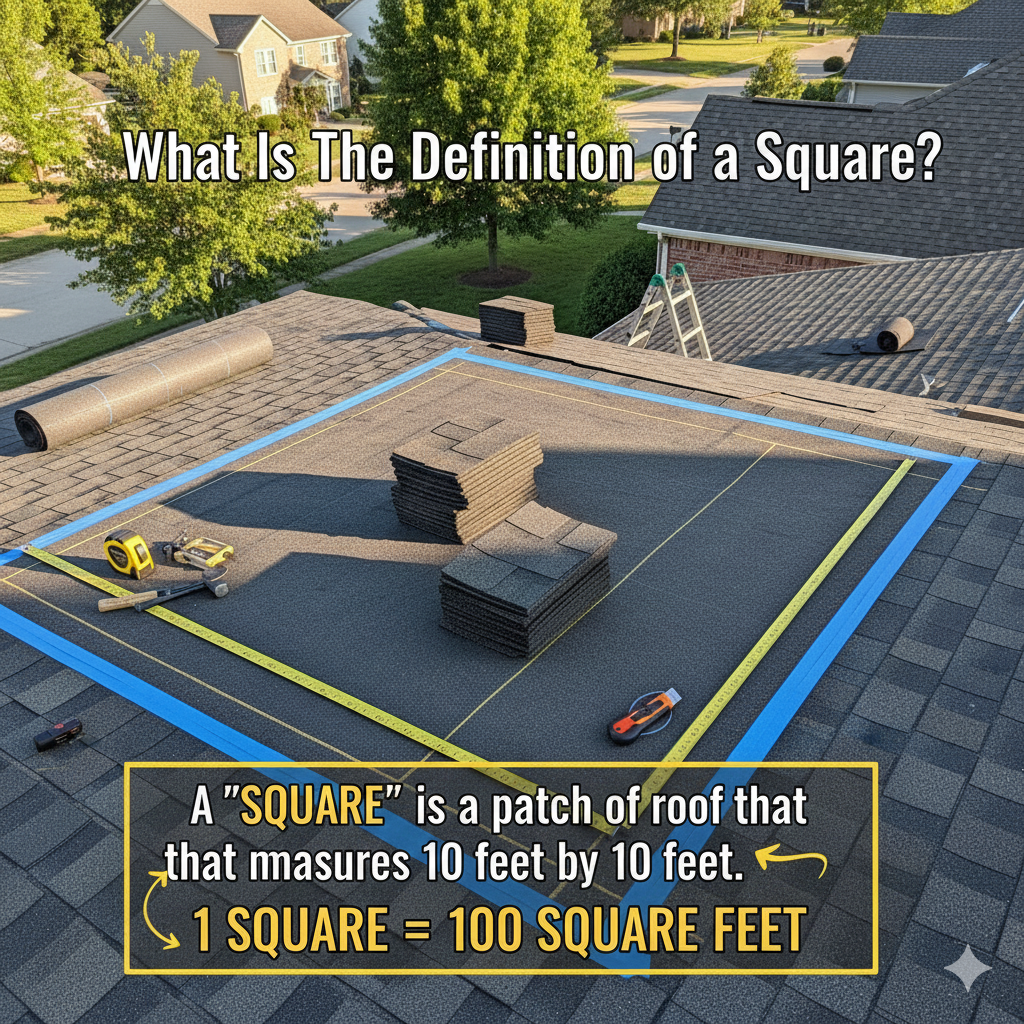
What Is the Definition of a Square?
To truly understand what is a square in roofing, you must look at the geometry of the roof surface. A “square” is a patch of roof that measures 10 feet by 10 feet. When you multiply 10 feet by 10 feet, you get 100 square feet. Therefore, one square equals 100 square feet. This is the golden rule of roofing estimates.
Contractors use this term because roofs are large. Dealing with thousands of square feet can get cumbersome mathematically. By reducing the number to squares, calculations become faster. If you know what is a square in roofing, you can quickly estimate that a bundle of standard 3-tab shingles usually covers one-third of a square. Therefore, you generally need three bundles to cover one square.
It is important to note that the term “square” refers to the roof area, not the floor area of your house. Because roofs have slopes and overhangs, the roof’s square footage will always be larger than the home’s footprint. Comprehending what is a square in roofing helps you account for pitch multipliers and waste factors that increase the total material needed.
How to Find Your Roof Size in Squares
Figuring out how to find the total number of squares on your home is a crucial skill. Once you know what is a square in roofing, you can grab a tape measure and start calculating.
-
Measure the Length and Width: Start by measuring the length and width of each plane of your roof. If you cannot access the roof safely, you can measure the ground dimensions and adjust for the overhangs and slope later.
-
Calculate Area: Multiply the length by the width to get the area in square feet for each section.
-
Sum the Sections: Add all the areas together to get the total square footage.
-
Divide by 100: This is the key step in understanding what is a square in roofing. Take your total square footage and divide it by 100.
-
Example: If your total roof area is 2,400 square feet.
-
2,400 ÷ 100 = 24 squares.
-
By applying the logic of what is a square in roofing, you transform a large, unwieldy number into a manageable figure for ordering materials. Remember to always add a percentage for waste. Most professionals add 10% to 15% to the total number of squares to account for cutting and mistakes.
How to Buy Materials Based on Squares
Knowing how to buy materials becomes much easier when you understand what is a square in roofing. Whether you are at a big-box store or a specialized supply house, pricing is often listed per square or per bundle.
-
Shingles: As mentioned, standard shingles come in bundles. Three bundles usually make one square. If you need 30 squares, you need 90 bundles.
-
Underlayment: Rolls of roofing felt or synthetic underlayment are sold by the square as well. A typical roll might cover 2 or 4 squares.
-
Flashing and Trim: While often sold by the linear foot, you estimate the total length needed based on the perimeter of your squares.
When you ask a supplier what is a square in roofing regarding their specific products, they might tell you that heavier, architectural shingles require four bundles per square instead of three. This distinction is vital for your budget. Always check the packaging, which will explicitly state the coverage area. If a package says “33.3 sq. ft.,” you know immediately that three of them equal 100 sq. ft., fitting the definition of what is a square in roofing perfectly.
How Much Do Different Materials Cost Per Square?
The question of how much a roof costs is directly tied to the concept of what is a square in roofing. Prices vary wildly based on the material chosen, but they are almost always quoted “per square.”
-
Asphalt Shingles: This is the most common material. You might pay between $100 and $150 per square for materials alone.
-
Metal Roofing: Metal is more durable but expensive. Costs can range from $300 to $900 per square depending on the metal type (steel, aluminum, copper).
-
Tile or Slate: These are premium materials. Knowing what is a square in roofing helps you prepare for prices exceeding $1,000 per square for authentic slate.
Labor is also calculated this way. A roofer might charge $200 per square for labor to install asphalt shingles, but $500 per square for difficult tile work. By understanding what is a square in roofing, you can separate material costs from labor costs in a quote. This transparency allows you to see if a contractor is overcharging for the work or the product.
Important Roofing Terminology and Measurements
In this section, we will delve deeper into specific variations of the term to ensure you have a comprehensive understanding.
Roofing One Square
When a contractor refers to “roofing one square,” they are discussing the act of installing materials over a 100-square-foot area. This task involves more than just nailing down shingles. It includes laying the underlayment, installing starter strips, and ensuring proper ventilation. Understanding what is a square in roofing means recognizing that “roofing one square” takes a specific amount of time—usually between one to two hours for an experienced roofer, depending on the pitch.
Square of Roof
The phrase “square of roof” is interchangeable with “roofing square.” It is simply the noun form. If a supplier asks, “How many squares of roof do you have?” they are asking for the total area divided by 100. This is the primary metric for logistics. A truck might be able to carry 40 squares of roof materials safely. If your house requires 50 squares, knowing what is a square in roofing helps you realize you will need two deliveries, potentially increasing your delivery fees.
What Is One Square of Roofing
To reiterate for clarity, what is one square of roofing is physically a 10-foot by 10-foot area. However, it can also be a 2-foot by 50-foot area. The shape does not matter; only the total area matters. This is crucial for complex roof lines with valleys and dormers. You might have long, thin strips of roof, but as long as they add up to 100 square feet, they constitute one square. This flexibility is central to the definition of what is a square in roofing.
What Is a Roofing Square in Measurement
Finally, looking at what is a roofing square in measurement from a geometric perspective helps with waste calculation. If you have a triangular roof section, you calculate the area (base x height / 2). If that triangle is 50 square feet, it is half a square. Contractors will round up. You cannot buy half a bundle of shingles easily. Therefore, understanding what is a square in roofing implies understanding that you must always round up to the nearest full bundle or square to ensure you do not run short.
How Long Does It Take to Install a Square?
Time management is critical in construction. The question of “how long” is often answered using the metric of what is a square in roofing.
For a standard, walkable pitch roof with asphalt shingles:
-
Removal: Tearing off old shingles might take 20 to 30 minutes per square.
-
Installation: Installing new shingles generally takes 45 to 60 minutes per square for a two-person crew.
Complex roofs change this equation. If the roof is steep (requiring safety harnesses) or has many valleys, the time per square increases significantly. Understanding what is a square in roofing allows you to audit the timeline. If a contractor claims it will take two weeks to do a 20-square roof, and you know a pro can do 5-8 squares a day, you might want to ask questions about their crew size or efficiency.

How to Do the Installation Correctly
Knowing what is a square in roofing is only the start; knowing how to execute the work is the next step. Installation requires precision.
-
Preparation: Ensure the deck is clean. One square of decking must be smooth for the square of shingles to lay flat.
-
Drip Edge: Install metal drip edge along the eaves.
-
Underlayment: Roll out the felt paper. Since you know what is a square in roofing, you know exactly how many feet of paper you need to cover the area without excessive overlap waste.
-
Shingling: Start at the bottom and work up. Maintain a staggered pattern so water cannot seep through the vertical joints.
-
Nailing: Use the correct number of nails per shingle (usually 4 to 6).
If you miscalculate what is a square in roofing, you might end up with a strip of roof at the peak with no shingles, leaving your home exposed to the elements. Accuracy is key.

Maintenance is often priced by the square as well. When asking how to clean your roof, professionals will ask for the size to give a quote.
-
Soft Wash: This involves using chemicals to kill moss and algae. Prices are often $0.20 to $0.40 per square foot, or $20 to $40 per square.
-
Pressure Washing: Not recommended for asphalt, but useful for tile.
Knowing what is a square in roofing helps you gauge the fairness of a cleaning quote. If you have a 30-square roof and someone quotes you $2,000 for a cleaning, that is over $65 per square, which might be high depending on your region. Regular cleaning preserves the integrity of each square, ensuring the materials last their full lifespan.
Advantages and Challenges of Using Squares
There are distinct pros and cons to using this measurement system. Understanding what is a square in roofing helps you navigate them.
Advantages:
* Simplicity: It simplifies large numbers. 30 is easier to say and write than 3,000.
* Standardization: Every supplier and contractor knows what is a square in roofing. It is a universal language in the trade.
* Bundling: Materials are packaged to align with squares, making math easy.
Challenges:
* Waste Calculation: Beginners often forget that a square on the roof is different from a square on the ground due to slope. Misunderstanding what is a square in roofing in relation to pitch can lead to material shortages.
* Rounding Errors: Rounding to the nearest square can sometimes lead to overbuying significantly if the roof is small.
Despite the challenges, the benefits of the system far outweigh the downsides. Once you master what is a square in roofing, project management becomes much smoother.
How to Calculate Pitch Multipliers
This is an advanced but necessary part of determining what is a square in roofing for ordering purposes. A steep roof has more surface area than a flat roof covering the same house footprint.
-
Determine Pitch: This is usually written as “4/12” or “8/12,” meaning the roof rises 4 inches for every 12 inches of run.
-
Find the Multiplier:
-
4/12 pitch multiplier = 1.054
-
8/12 pitch multiplier = 1.202
-
-
Apply the Math: Multiply your ground floor square footage by the multiplier.
-
Example: 2,000 sq. ft. ground area x 1.202 (8/12 pitch) = 2,404 roof sq. ft.
-
2,404 ÷ 100 = 24.04 squares.
-
If you ignored the pitch and simply asked what is a square in roofing based on the floor plan, you would have ordered 20 squares and been short by over 4 squares. This is a critical error that delays projects.
What Is the Cost of Mistakes?
Failing to understand what is a square in roofing can be expensive. If you order too much, you are stuck with heavy materials that are hard to return. Most suppliers charge a “restocking fee” of 15% to 25% to take materials back.
If you order too little because you miscalculated what is a square in roofing, you have to stop work. This creates:
-
Labor downtime: You still have to pay the crew.
-
Delivery fees: You have to pay for a second truck to bring the missing bundles.
-
Color mismatch: Shingles have lot numbers. Buying a few bundles a week later might result in a slight color variation that makes your roof look patchy.
Accurately defining what is a square in roofing prevents these financial leaks. It ensures that the project flows smoothly from start to finish without emergency trips to the hardware store.

FAQ
What if my roof is exactly 2,450 square feet?
You would round up. Since 2,450 sq. ft. is 24.5 squares, and you cannot usually buy half-units easily, you would treat this as 25 squares. Understanding what is a square in roofing means always erring on the side of having extra material rather than running short.
Does a “square” include the waste factor?
No. The definition of what is a square in roofing refers strictly to the measurement of the area (100 sq. ft.). You must add your waste factor (usually 10-15%) on top of the calculated squares. If you have 20 squares of actual roof, you should buy materials for 22 or 23 squares.
Is a square the same for siding?
Yes. Interestingly, the concept of what is a square in roofing applies to siding as well. One square of vinyl siding covers 100 square feet of wall area. The terminology is consistent across the exterior construction trades.
Can I measure my roof from the ground?
Yes, but it requires geometry. You can measure the perimeter of the house and estimate the slope. However, for the most accurate calculation of what is a square in roofing, physical measurement or using satellite imagery software is recommended.
Why do contractors charge per square instead of per hour?
Charging per square is performance-based. It incentivizes the crew to work efficiently. If they know exactly what is a square in roofing and how much they get paid for it, they can calculate their earnings based on speed and quality, rather than just clocking hours.
Conclusion
Mastering the terminology of home improvement is the best way to protect your investment. The answer to the question what is a square in roofing is simple on the surface—it is a 10-foot by 10-foot area, or 100 square feet. However, as we have explored, the implications of this measurement run deep. It affects how you budget, how you order materials, how you estimate labor time, and how you communicate with professionals.
Whether you are a DIY enthusiast looking to patch a leak or a homeowner overseeing a full roof replacement, keeping the concept of what is a square in roofing at the forefront of your planning will save you time and money. It allows you to check the math of your contractor, ensuring you are paying for the correct amount of material and labor.
Remember that estimating is an art that uses math. Always account for the pitch of your roof and the necessary waste factor. Never simply buy exactly the number of squares your roof measures; always add that buffer. By fully understanding what is a square in roofing, you transform from a novice homeowner into an informed project manager, ready to tackle your roofing project with confidence and precision.
📐 Other Resources
Explore these helpful guides to understand what a roofing square is, how it’s calculated, and why it matters in roofing estimates:
-
GAF – What Is a Roofing Square? – Clear explanation of roofing squares and material calculations.
-
Bill Ragan Roofing – Roofing Square Explained – Practical guide on how roofers measure roofs using squares.
-
Rocket Renovation – Roofing Square Basics – Easy-to-understand breakdown with real-world examples.
🔎 Other Helpful Articles
-
Metal Roof Underlayment – How underlayment affects roof performance.
-
Spanish Roof Bracket – Brackets and mounting systems for tile roofs.
-
New Metal Roof Cost in Fort Walton Beach, Florida – Local cost guide for metal roof installation.