
Flat Roof Scupper: Great Installation Steps
Flat Roof Scupper: Best Tips for Drainage
Water is the ultimate enemy of any building structure. When dealing with commercial buildings or modern residential homes, effective water management becomes even more critical. Unlike pitched roofs that rely on gravity and slopes to shed rain quickly, flat roofs face the constant threat of ponding water. This is where a reliable drainage system comes into play. Among the various solutions available, the flat roof scupper stands out as a highly effective, low-maintenance option for moving water off your roof and away from your foundation.
Understanding how these systems work is essential for any property owner. Whether you are constructing a new building or retrofitting an older one, choosing the right drainage method can save you thousands of dollars in repairs. A flat roof scupper offers a simple yet ingenious design that channels water through a parapet wall, preventing the dangerous accumulation of weight that can compromise structural integrity. Throughout this guide, we will explore every aspect of these drainage devices, ensuring you have the knowledge to make informed decisions for your property.
What Is a Flat Roof Scupper?
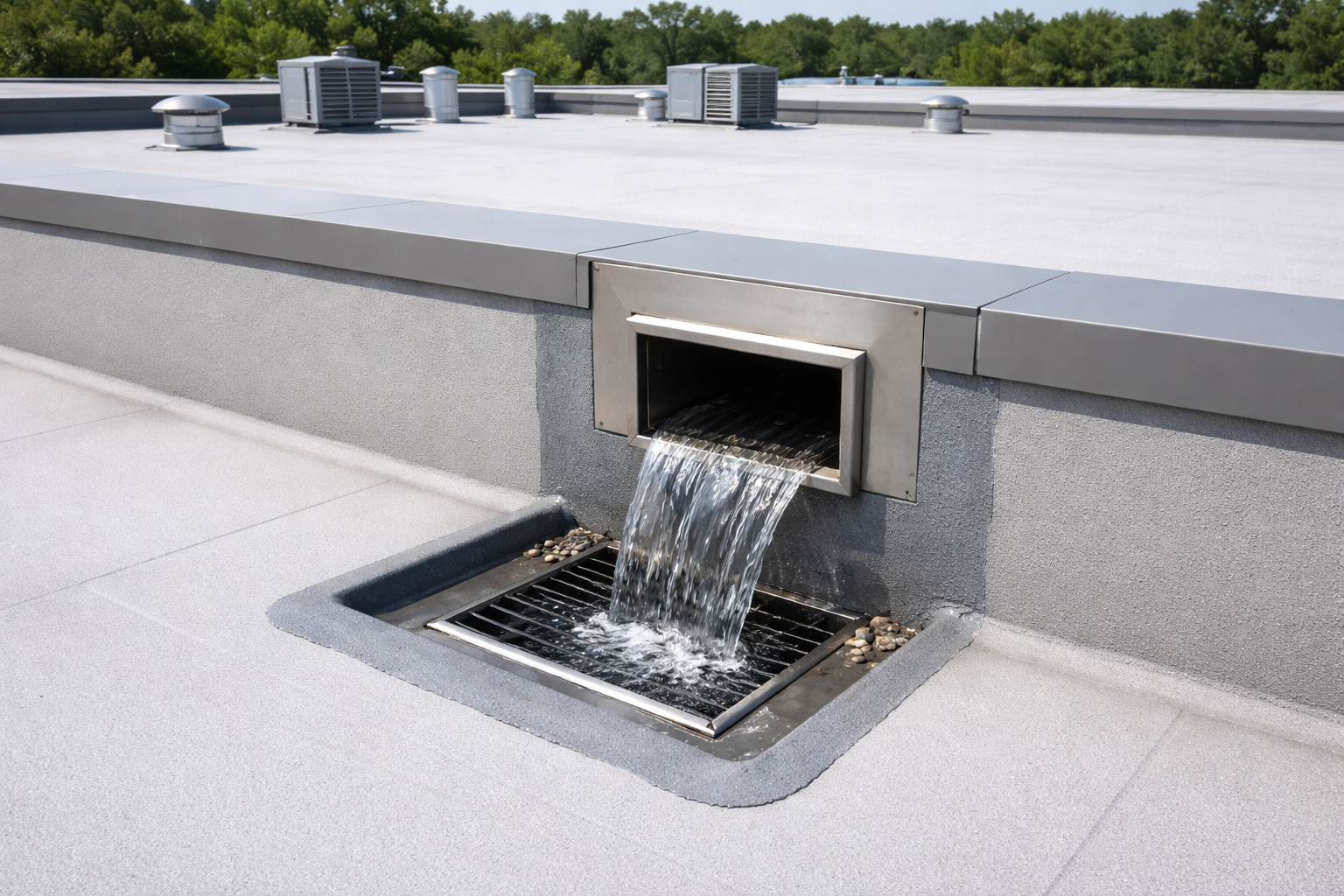
At its core, a flat roof scupper is a drainage opening or outlet installed through a parapet wall or gravel stop on a flat or low-slope roof. It functions as a specialized channel that allows water to exit the roof surface and drain into a downspout or directly onto the ground below. Think of it as a bridge between the horizontal surface of your roof and the vertical drainage system. Without this critical component, water would remain trapped behind the parapet walls, leading to leaks, membrane deterioration, and potential collapse.
The design of a flat roof scupper is deceptively simple, but its role is complex. It must be integrated seamlessly with the roof membrane to ensure a watertight seal. Most scuppers are fabricated from durable metals like copper, aluminum, or galvanized steel to withstand exposure to the elements. They come in various shapes—rectangular and circular being the most common—to fit different architectural styles and flow requirements. By providing a direct path for water to escape, a flat roof scupper acts as a safety valve for your building.
The Mechanics of Scupper Drains
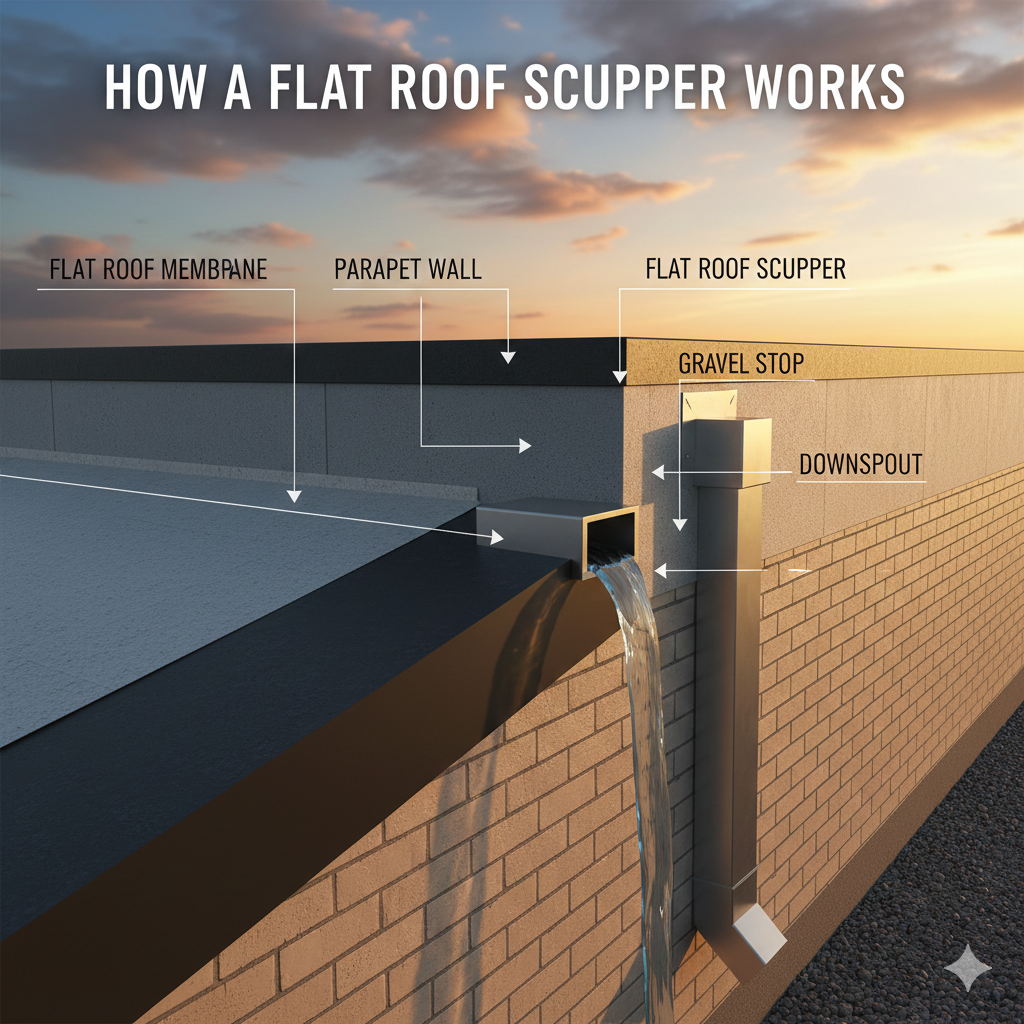
To truly appreciate the utility of a flat roof scupper, one must understand the mechanics of how it operates within the broader context of roof drainage. Gravity is the primary force at work here. For the scupper to function correctly, the roof must have a slight pitch or taper directing water toward the parapet walls where the scuppers are located. If the roof is perfectly flat or sags in the middle, water will never reach the flat roof scupper, rendering it useless. Therefore, the relationship between the roof insulation taper and the scupper placement is symbiotic.
Once the water reaches the edge, it flows into the scupper box or channel. A high-quality flat roof scupper will have a wide intake to handle heavy rainfall without backing up. As water passes through the wall, it exits via a spout. In many configurations, this spout leads into a conductor head (leader box) and down a downspout. This ensures the water doesn’t just pour down the side of the building, which could stain the façade or erode the foundation.
-
Primary function: Moving bulk water off the roof deck.
-
Secondary function: Acting as an emergency overflow if internal drains fail.
-
Aesthetic function: Adding architectural detail through custom metalwork.
The efficiency of a flat roof scupper depends heavily on its size. A scupper that is too small for the roof’s surface area will create a bottleneck during storms. Conversely, a properly sized scupper allows for rapid evacuation of water, keeping the roof load light and the structure safe.
How to Find the Right Scupper
Finding the correct flat roof scupper involves more than just picking a metal box off a shelf. You need to consider the specific requirements of your building. Start by calculating the roof area that needs to be drained. Plumbing codes often dictate the size of the scupper opening based on the square footage of the roof and the average rainfall intensity in your region. A flat roof scupper that is undersized is a code violation and a liability.
Next, look at the material compatibility. If you have a TPO or PVC roof, you might look for a flat roof scupper clad in a similar material or one that comes with a weldable flashing skirt. This ensures a chemical bond between the drain and the roof, minimizing leak risks. For modified bitumen or built-up roofs, copper or lead-coated copper scuppers are traditional favorites due to their longevity and solderability.
You can find these products at:
-
Specialized Roofing Supply Houses: They carry professional-grade stock.
-
Custom Sheet Metal Shops: Necessary for non-standard parapet depths.
-
Online Industrial Retailers: Good for standard sizes but verify specifications carefully.
When searching, always prioritize quality over the lowest price. A cheap flat roof scupper made from thin-gauge metal may rust or deform under the weight of snow and ice, leading to failure when you need it most.
Core Concepts: Scuppers, Drains, and Boxes
In this section, we will delve deeper into four specific topics essential to understanding the flat roof scupper ecosystem.
1: What is a scupper on a flat roof?
As previously touched upon, this is the physical outlet installed in the wall. However, technically speaking, it represents the intersection of waterproofing and drainage. It is a critical detail where the horizontal roof membrane must turn up and pass through a vertical wall. This makes the flat roof scupper a high-risk area for leaks if not flashed correctly. It serves as an exterior drainage point, contrasting with internal drains that go down through the center of a building.
2: Scupper drain flat roof
The term “scupper drain flat roof” refers to the entire system of drainage relying on perimeter outlets. Unlike internal drains, which stay warmer inside the building envelope, a flat roof scupper is exposed to freezing temperatures. This means a flat roof scupper is more prone to icing over in winter. To combat this, the drain design often includes a tapered bottom to accelerate water flow, preventing it from sitting and freezing in the throat of the scupper.
3: How to install a scupper on a flat roof
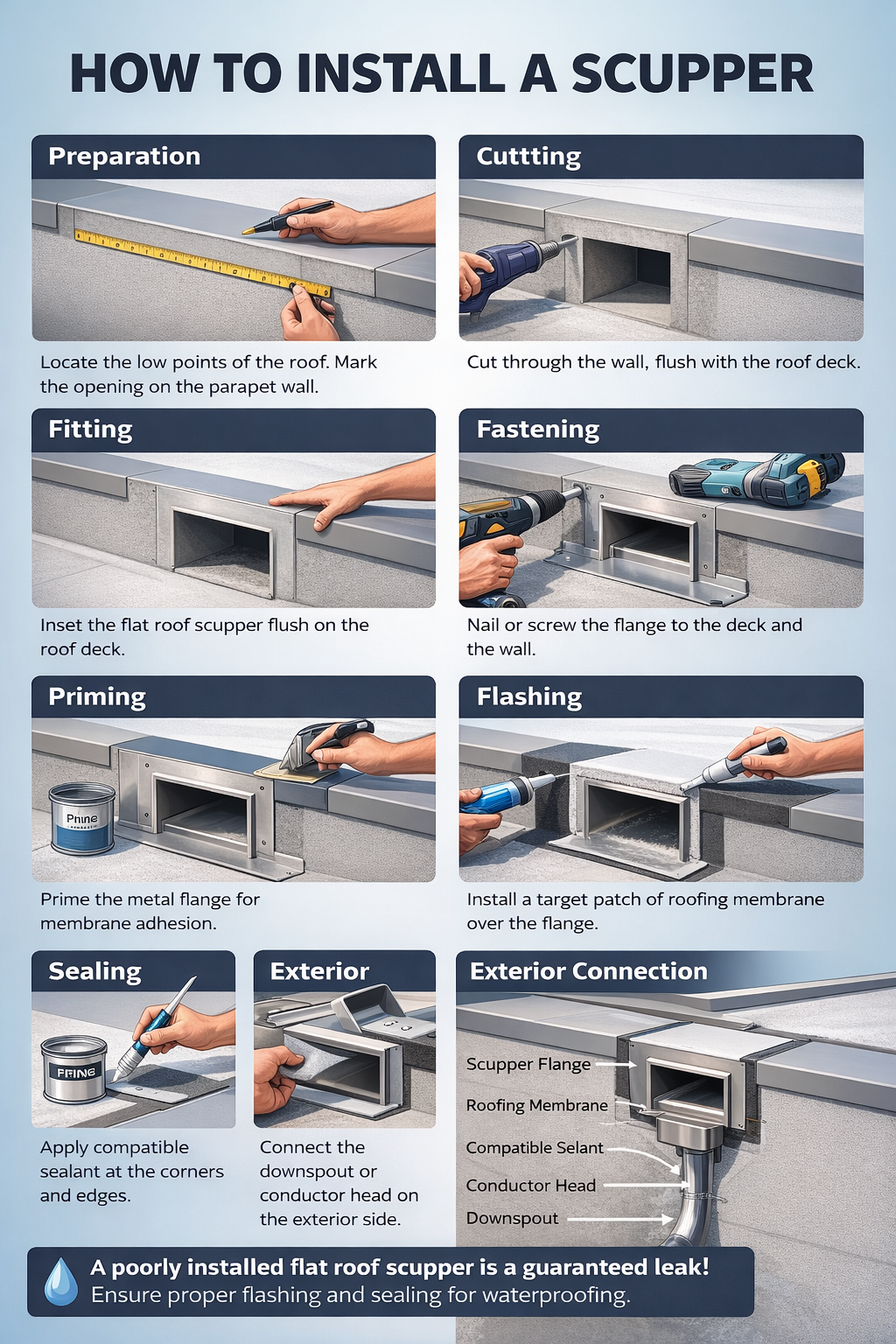
Installation is a precise process. First, a hole is cut through the parapet wall and exterior fascia. The flat roof scupper is inserted, ensuring the flange sits flush on the roof deck (often recessed slightly to prevent a water dam). The flange is then fastened to the deck and wall. Crucially, the roofing membrane is installed over the flange (stripping in) to create a watertight seal. On the exterior, a faceplate seals the gap between the scupper chute and the wall. Finally, the connection to the downspout is made.
4: Flat roof scupper box
A flat roof scupper often empties into a scupper box or conductor head. This is an external metal box mounted on the outside wall. It acts as a funnel, catching the water shooting out of the scupper and directing it into the downspout. The box is open at the top, which serves as a vacuum breaker and allows for overflow if the downspout clogs. This prevents water from backing up into the scupper and back onto the roof.
How to Buy the Best Scupper
When you are ready to buy a flat roof scupper, you must have your measurements exact. You need to know the wall thickness. A standard scupper might be designed for a 6-inch wall, but if your parapet is 12 inches thick, the standard unit won’t reach the exterior. Custom ordering is very common in this niche. When contacting a fabricator to buy a flat roof scupper, provide them with the wall depth, the desired opening size, and the flange width.
Consider the “flange” carefully. The flange is the flat metal rim that sits on the roof deck. A wider flange generally offers a better surface for adhering the roofing membrane. When you buy a flat roof scupper, ask for a minimum 4-inch flange. This gives the roofer plenty of room to create a secure, watertight bond.
Additionally, check the gauge of the metal.
-
24-gauge steel: A common standard for residential use.
-
22-gauge steel: Better for commercial applications.
-
16-ounce copper: Excellent for durability and aesthetics.
Do not overlook the finish. If you are buying a steel flat roof scupper, it should be galvanized or Kynar-coated to resist rust. Buying raw steel and painting it later is a recipe for peeling paint and corrosion within a few years.
What Is the Cost?
The cost of a flat roof scupper varies significantly based on material, size, and customization. For a basic, standard-size galvanized steel scupper (e.g., 4″ x 6″ opening with an 8″ wall depth), you might pay between $80 and $150 per unit. However, this is just for the metal component itself. High-end materials change the equation drastically. A custom-fabricated copper flat roof scupper can easily run between $300 and $600 per unit due to the cost of copper and the skilled labor required to solder the joints.
If you require a stainless steel flat roof scupper for a corrosive industrial environment or a coastal home, expect prices similar to copper. Plastic or TPO-clad scuppers are generally cheaper, ranging from $50 to $100, but they may lack the durability of metal in harsh freeze-thaw cycles.
Retrofitting a flat roof scupper into an existing wall is labor-intensive. A contractor has to open the wall, remove old flashing, install the new unit, and patch both the interior and exterior finishes. This can cost anywhere from $500 to $1,500 per scupper, depending on the complexity of the wall cladding (e.g., stucco or brick is harder to work with than siding).
Advantages of Scupper Systems
Choosing a flat roof scupper system offers distinct advantages over internal drains or gutter systems. The most significant benefit is maintenance visibility. If a flat roof scupper is clogged, you can usually see it from the ground. You will see water spilling over the sides or no water coming out when it should be. Internal drains can clog silently, causing massive water buildup that is only discovered when the roof leaks or collapses.
Another advantage is the cost-effectiveness of the flat roof scupper. There is no internal piping to run through the building. Internal drains require plumbing to be routed through the ceiling plenum, which increases construction costs and complicates future renovations. A flat roof scupper keeps the water outside the building envelope, reducing the risk of internal pipe bursts or condensation issues.
Furthermore, a flat roof scupper is less likely to clog with small debris than a small drain strainer. The opening is typically wide and rectangular, allowing leaves and twigs to flush through more easily than they would through a dome strainer. This makes the flat roof scupper an excellent choice for roofs surrounded by trees, provided regular maintenance is performed.
Challenges and Limitations
Despite their benefits, a flat roof scupper is not a perfect solution for every building. The primary challenge is their susceptibility to freezing. Because the scupper passes through the cold parapet wall, water trickling through can freeze in the throat of the scupper. This ice dam can block the drain completely. In very cold climates, internal drains are often preferred because the heat of the building keeps the pipes flowing. If you use a flat roof scupper in a cold zone, you may need to install heat tape to keep the channel open.
Another challenge is the reliance on roof slope. A flat roof scupper is located at the perimeter. If the roof structure deflects in the center over time, water will pond in the middle and never reach the scupper. This requires the use of tapered insulation to force water to the edges, which adds to the roofing cost.
How to Install a Scupper
We briefly touched on installation in the core concepts, but let’s detail the procedure for a typical retrofit, as this is where most homeowners encounter issues. Installing a flat roof scupper requires a skilled hand to ensure waterproofing.
-
Preparation: Locate the low points of the roof. This is where the flat roof scupper must go. Mark the opening on the parapet wall.
-
Cutting: Cut through the wall materials. Ensure the bottom of the hole is flush with the roof deck. If it’s too high, you create a permanent pond.
-
Fitting: Insert the flat roof scupper. The flange must rest flat on the roof deck. If the scupper has a cant strip angle, ensure it matches the roof edge detail.
-
Fastening: Nail or screw the flange to the deck and the wall. Use appropriate fasteners for the substrate (wood, concrete, or steel).
-
Priming: Prime the metal flange to ensure the roofing membrane adheres.
-
Flashing: This is the most critical step. Install a target patch of roofing membrane over the flange, extending at least 6 inches onto the roof and into the throat of the flat roof scupper. Roll it tight to remove air bubbles.
-
Sealing: Apply compatible sealant at the corners and edges where the membrane meets the metal.
-
Exterior Connection: Connect the conductor head or downspout to the exterior side of the scupper.
A poorly installed flat roof scupper is a guaranteed leak. The interface between the metal scupper and the roof membrane is subject to differential movement due to thermal expansion. If not detailed correctly, this bond will break, and water will enter the wall cavity.
How to Clean and Maintain
Maintenance is key to the longevity of your flat roof scupper. You should inspect your scuppers at least twice a year—once in the spring and once in the fall—and immediately after any major storms.
How to clean:
Start by removing any debris from the opening. Leaves, plastic bags, and twigs often accumulate at the mouth of the flat roof scupper. Use a gloved hand or a small plastic rake to clear the blockage. Do not use sharp metal tools that could puncture the roofing membrane surrounding the scupper.
Check the throat of the flat roof scupper. Sometimes, a bird’s nest or a tennis ball can get wedged inside the wall passage. You may need a plumber’s snake to dislodge obstructions deep inside the chute. Once the large debris is gone, flush the flat roof scupper with a garden hose. Watch the water exit the downspout. If it backs up, the blockage is in the downspout, not the scupper itself.
Maintenance checks:
Inspect the sealant around the flat roof scupper. If the caulking is cracked or peeling, remove it and re-apply a high-quality polyurethane sealant. Check for rust on the metal. If you see surface rust on a galvanized flat roof scupper, sand it down and apply a rust-inhibiting paint. If the rust has eaten through the metal, the entire unit must be replaced.
FAQ : Flat roof scupper
What is the difference between a scupper and a gutter?
A gutter hangs on the edge of the roof to catch runoff. A flat roof scupper acts as a penetration through a wall to let water out. Scuppers often feed into gutters or downspouts, but they are distinct components used primarily on buildings with parapet walls.
Can I use a scupper on a sloped roof?
Generally, no. Scuppers are designed for flat or low-slope roofs with parapet walls. Sloped roofs use eaves and gutters. However, some modern architecture uses parapet walls on sloped roofs, in which case a flat roof scupper could be utilized.
How many scuppers do I need?
Building codes dictate this based on roof area and rainfall rate. Generally, you need at least two drainage points for any roof section to provide redundancy. If one flat roof scupper clogs, the other takes the load.
Why is my scupper leaking into the wall?
This usually happens because the seal between the roof membrane and the metal flange has failed. It could also be that the flat roof scupper itself has a split weld inside the wall.
Do scuppers need overflow protection?
Yes. Ideally, you should have secondary drainage. This can be a separate set of scuppers installed 2 inches higher than the primary flat roof scupper. If the water rises to the level of the secondary scuppers, you know the primaries are blocked.

Conclusion
The flat roof scupper is an unsung hero of commercial and residential roofing. It provides a simple, effective, and visually manageable way to protect your property from water damage. While they appear to be simple metal chutes, their design, installation, and maintenance require careful attention to detail. From ensuring you choose the right material to avoid corrosion, to calculating the correct size for your rainfall zone, every decision matters.
A well-maintained flat roof scupper system can last for decades, keeping your roof dry and your foundation secure. Conversely, neglecting these critical points can lead to catastrophic water intrusion, rot, and structural failure. By following the guidelines in this article—checking your scuppers regularly, installing them with precision, and addressing repairs immediately—you ensure that your building remains watertight. Whether you are an owner, a facility manager, or a contractor, respecting the function of the flat roof scupper is essential for long-term building health. Remember, when it rains, your scuppers are your first line of defense. Treat them well, and they will protect your investment for years to come.
Other Resources
Colony Roofers – Educational article explaining what roof scuppers are and how they function in roof drainage systems.
CopperLab – Product collection featuring parapet drains and roof scuppers for drainage applications.
Rhoden Roofing – Informational article comparing roof drains and scuppers and when each is used.
First American Roofing – Blog post describing roof scuppers, their purpose, and common installation considerations.
Other Helpful Articles
Painting Roof Tiles Color – Article discussing color options and considerations when painting roof tiles.
Ultimate Cherry Hill Roofing Guide – Comprehensive guide covering roofing topics relevant to Cherry Hill homeowners.
Flat Roof Bubble Repair – Guide explaining how flat roof bubbles form and common repair approaches.