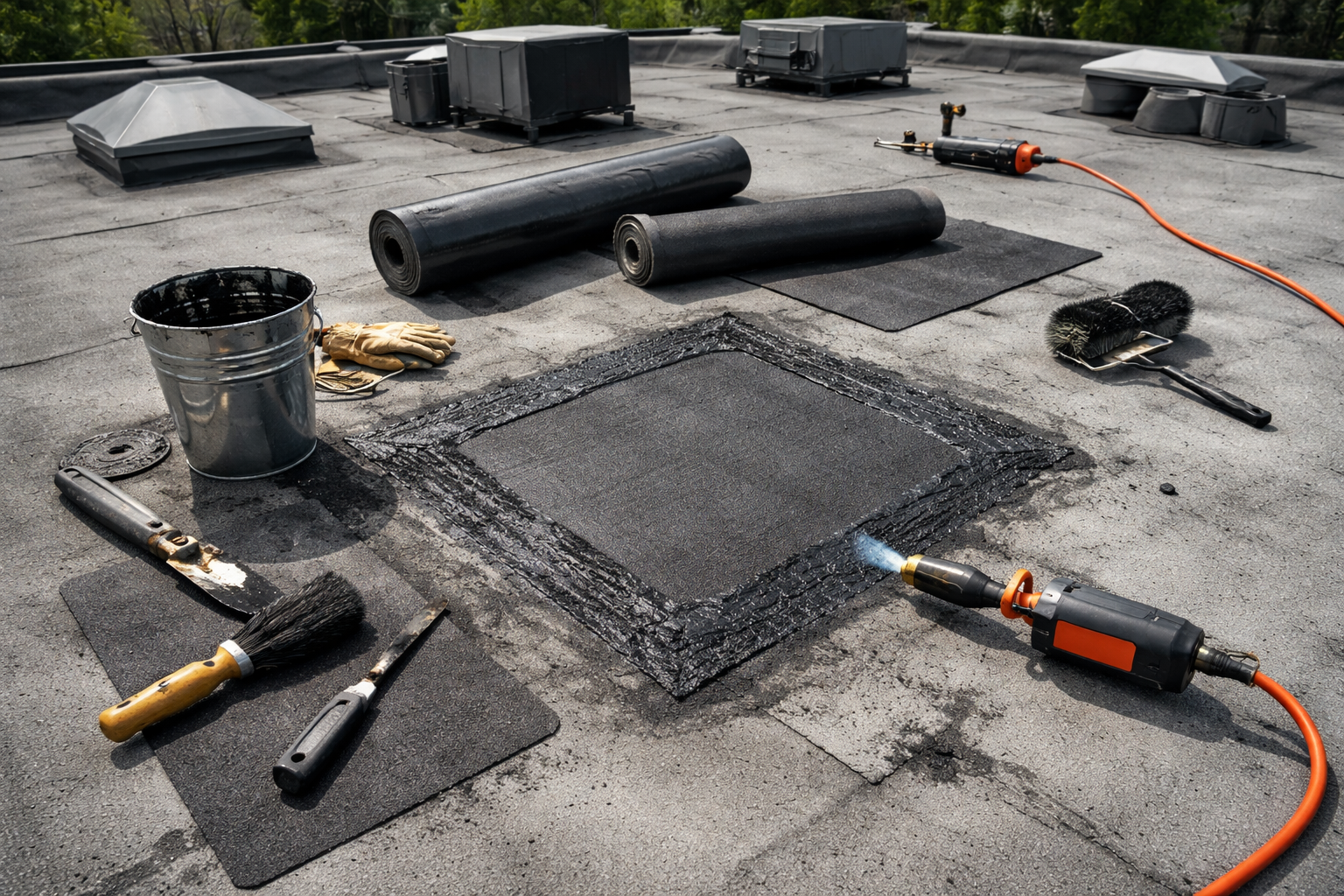
Modified Bitumen Roof Repair: Best Ways
Modified Bitumen Roof Repair
A sturdy roof is the first line of defense against the elements, and understanding modified bitumen roof repair is essential for any property owner with a flat or low-slope structure. Whether you manage a commercial warehouse or a residential extension, the integrity of your roofing system dictates the safety of the assets below. Neglecting small cracks or blisters can lead to catastrophic water damage, making timely modified bitumen roof repair a critical maintenance task.
In this comprehensive guide, we will explore everything you need to know about modified bitumen roof repair, from identifying early warning signs to executing a professional-grade fix. By mastering these techniques, you ensure that your modified bitumen roof repair project not only solves immediate leaks but also extends the overall lifespan of your building’s envelope. We will delve into costs, materials, and expert strategies to make your modified bitumen roof repair successful.
What Is Modified Bitumen Roofing?
Modified bitumen roofing is an evolution of the traditional built-up roofing (BUR) asphalt system. It consists of asphalt that has been chemically modified with either plastic or rubber additives to improve flexibility, durability, and temperature resistance. When you engage in modified bitumen roof repair, you are typically working with multi-layered sheets that are reinforced with fiberglass or polyester mats. These layers create a watertight barrier that is exceptionally tough against foot traffic and environmental stressors.
The primary benefit of this material is its versatility. Because the asphalt is modified, it can expand and contract with the building without cracking, which significantly reduces the frequency of modified bitumen roof repair needs compared to older asphalt systems. However, no material is invincible. UV radiation, standing water, and physical impacts can eventually compromise the surface, necessitating a targeted modified bitumen roof repair.
Understanding the composition of your roof is the first step in any modified bitumen roof repair project. Whether you have an SBS (styrene-butadiene-styrene) or APP (atactic polypropylene) system determines the specific modified bitumen roof repair method you must use. Matching the repair material to the existing roof is non-negotiable for a lasting bond.
Identifying Damage Before Repair
Before you can execute a modified bitumen roof repair, you must accurately identify the scope of the damage. Start by inspecting the roof for blisters, which are raised bubbles indicating trapped moisture or air between the layers. If you step on a blister and it feels spongy, you likely need an immediate modified bitumen roof repair to prevent water from seeping into the insulation below.
Cracking, also known as “alligatoring,” is another common sign that modified bitumen roof repair is imminent. This occurs when the sun’s UV rays dry out the asphalt, causing it to shrink and crack. While minor surface crazing is normal, deep cracks that expose the reinforcement mat require a robust modified bitumen roof repair strategy. Additionally, check all flashing points around vents, chimneys, and walls, as these are the most common failure points requiring modified bitumen roof repair.
Ponding water—water that stays on the roof for more than 48 hours—is a silent killer of flat roofs. While the membrane is waterproof, standing water can degrade the seams over time. If you notice persistent puddles, your modified bitumen roof repair plan might need to include improving drainage or installing crickets to divert water. Ignoring these signs will only escalate the cost and complexity of the eventual modified bitumen roof repair.

How To Find Reliable Contractors
Finding a skilled professional for modified bitumen roof repair can be challenging, as flat roofing requires specific expertise different from standard residential shingling. Start by searching for contractors who specialize in commercial or low-slope roofing. When interviewing candidates for your modified bitumen roof repair, ask for proof of certification with major modified bitumen manufacturers.
A reliable contractor should be able to explain their modified bitumen roof repair methodology clearly. Will they use a torch-down method or cold adhesives? Their answer should align with your building’s safety requirements and the specific type of membrane you have. Always request a detailed written estimate that breaks down the labor and material costs for the modified bitumen roof repair.
Check online reviews and ask for references from past clients who had a similar modified bitumen roof repair performed. A reputable roofer will have a portfolio of successful flat roof projects. Remember, the cheapest bid is rarely the best option for modified bitumen roof repair, as poor workmanship can lead to leaks that cost thousands more to fix later.
How To Buy The Right Materials
Purchasing the correct materials is the cornerstone of a durable modified bitumen roof repair. You cannot simply use generic roof tar; you need compatibility. If your roof is APP (plastic-modified), you generally need torch-grade repair materials. If it is SBS (rubber-modified), you should look for cold-process adhesives or rubberized asphalt cements for your modified bitumen roof repair.
When shopping for modified bitumen roof repair supplies, look for high-quality primer. Priming the surface is essential to ensure the new patch bonds to the old, weathered surface. Without primer, your modified bitumen roof repair is likely to peel off within a few months. You will also need granules that match your existing roof color to protect the repair asphalt from UV rays.
For DIY modified bitumen roof repair, self-adhering “peel and stick” repair membranes are often the best choice. These products eliminate the fire risk of open flames and are easier to handle for small patches. Ensure you buy enough material to overlap the damaged area by at least six inches on all sides to guarantee a watertight modified bitumen roof repair.
What Is The Cost of Repairs?
The financial aspect of modified bitumen roof repair varies based on the severity of the damage and the method used. On average, you can expect to pay between $4.00 and $7.50 per square foot for professional installation and repair work in 2026. However, minimum service charges for small modified bitumen roof repair visits often start around $300 to $500, regardless of the patch size.
Labor typically accounts for a significant portion of the modified bitumen roof repair cost. Because working with torch-down systems requires specific insurance and safety protocols, labor rates for these repairs can be higher than cold-applied methods. If your modified bitumen roof repair involves replacing wet insulation beneath the membrane, costs will rise significantly due to the added demolition and material disposal fees.
DIY modified bitumen roof repair can be much cheaper, with material costs for a simple patch kit ranging from $50 to $100. However, if you perform the repair incorrectly, you risk voiding your warranty. It is often more cost-effective in the long run to pay a professional for a guaranteed modified bitumen roof repair than to repeatedly fix a failed amateur attempt.
How To Clean The Surface
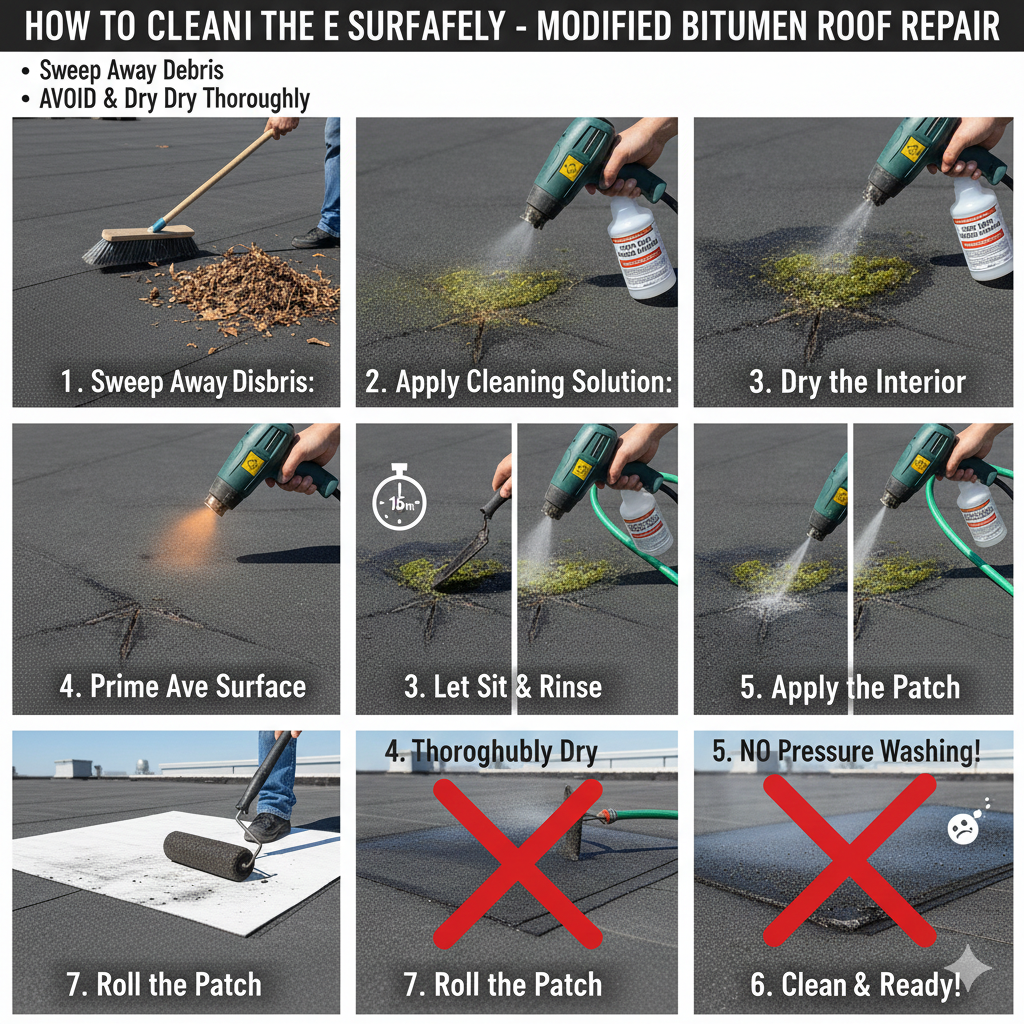
Proper cleaning is the most overlooked step in modified bitumen roof repair. You cannot adhere a new patch to a dirty, mossy, or dusty surface. Start by sweeping away all loose debris, leaves, and dirt from the area where the modified bitumen roof repair will take place. Use a stiff-bristle broom to dislodge embedded grime.
For a deeper clean, especially if algae or mold is present, use a solution of 50% water and 50% bleach. This mixture kills organic growth without damaging the bitumen. Spray the area and let it sit for 15 minutes before rinsing thoroughly with plain water. Ensure the area is completely dry before attempting any modified bitumen roof repair; trapping moisture under a patch is disastrous.
Avoid using pressure washers at high settings, as this can blast away the protective granules on the membrane. A gentle wash is sufficient to prepare the surface for modified bitumen roof repair. Once the area is clean and dry, you are ready to apply the primer, which acts as the bonding bridge for your repair materials.

How To Install Patches Safely
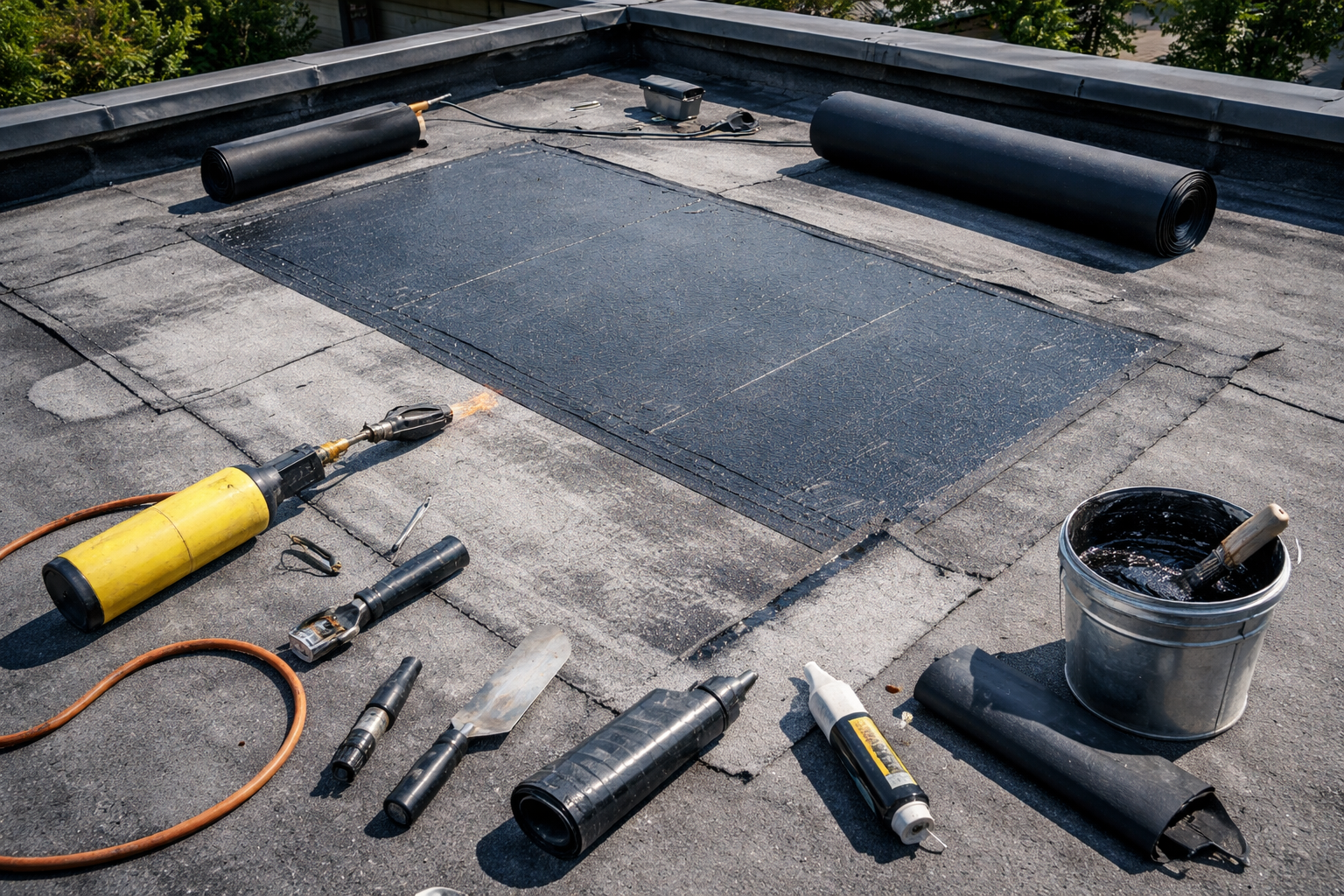
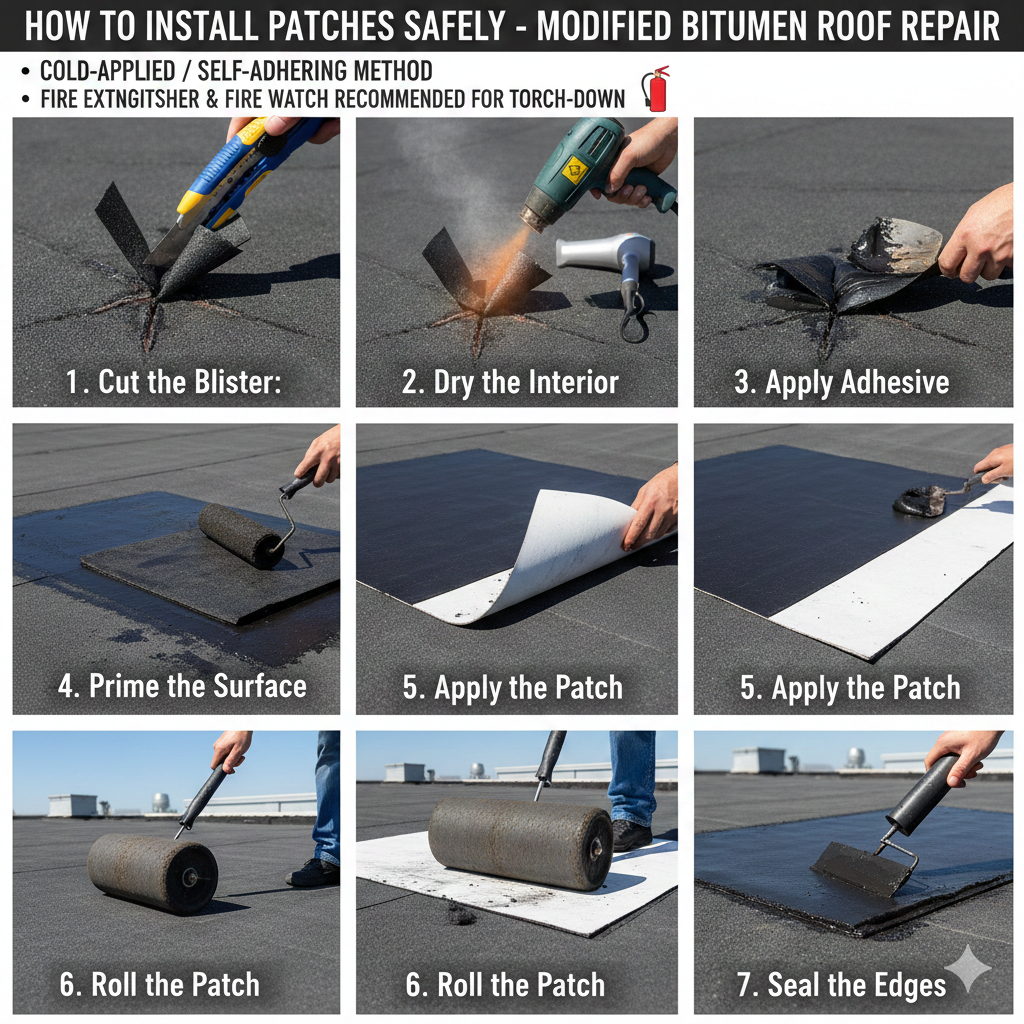
Safety is paramount when performing modified bitumen roof repair. If you are using a torch-down method, you must have a fire extinguisher on hand and ideally a fire watch person to monitor the area for smoldering debris. For most property owners, cold-applied or self-adhering patches are the safest route for modified bitumen roof repair.
-
Cut the Blister: If repairing a blister, slice it open in an “X” shape and peel back the flaps.
-
Dry the Interior: Use a heat gun (carefully) or hair dryer to ensure the substrate is bone dry.
-
Apply Adhesive: Trowel a layer of modified bitumen adhesive under the flaps and press them back down.
-
Prime the Surface: Apply asphalt primer to the area surrounding the cut.
-
Apply the Patch: Cut your modified bitumen roof repair membrane to extend 6 inches beyond the damage. Peel the backing and press it firmly into place.
-
Roll the Patch: Use a weighted roller to push out air bubbles and ensure adhesion.
-
Seal the Edges: Apply a bead of mastic along the edges of the patch to finalize the modified bitumen roof repair.

How To Do Emergency Fixes
Sometimes, leaks happen during a storm when a full modified bitumen roof repair is impossible. In these scenarios, you need a temporary emergency fix. Wet-patch roof cement is your best friend here. This product is designed to stick even in standing water, allowing you to stop the leak immediately and plan for a permanent modified bitumen roof repair later.
Locate the source of the leak and trowel a thick layer of wet-patch cement directly over the defect. Embed a piece of reinforcing mesh into the cement, and then add another layer of cement on top. This “three-course” method provides a robust temporary seal until weather permits a proper modified bitumen roof repair.
Do not rely on tarps alone, as wind can easily blow them off flat roofs. A chemical emergency seal is more reliable. However, remember that this is not a permanent solution. You must return to perform a proper modified bitumen roof repair once the roof is dry to ensure long-term structural integrity.
Advantages of Timely Maintenance
Proactive modified bitumen roof repair offers significant advantages. First and foremost, it extends the life of your roof. A well-maintained modified bitumen roof can last 20 to 30 years, whereas a neglected one might fail in 15. Regular modified bitumen roof repair prevents minor issues from becoming major capital expenditures.
Secondly, timely modified bitumen roof repair protects the insulation layer. Once insulation gets wet, it loses its R-value, leading to higher energy bills. By sealing leaks quickly, you maintain the building’s thermal efficiency. This energy-saving aspect makes the cost of modified bitumen roof repair an investment rather than just an expense.
Finally, keeping up with modified bitumen roof repair maintains your property value. A documented history of professional maintenance and repairs is a strong selling point for commercial and residential buildings. It proves to buyers that the building has been cared for, potentially increasing the final sale price.
Challenges You Might Face
Despite its benefits, modified bitumen roof repair comes with challenges. One major issue is material incompatibility. Using asphalt plastic cement on a rubber-based SBS roof can sometimes lead to chemical reactions that soften the membrane. Ensuring you have the exact right product for your modified bitumen roof repair is critical.
Another challenge is weather dependency. You cannot effectively perform modified bitumen roof repair in rain or extreme cold (unless using specialized cold-weather formulas). Adhesives may not cure properly below 40°F, leading to bond failure. Scheduling your modified bitumen roof repair during the right weather window is often the hardest part of the project.
Finding the source of a leak on a flat roof can also be difficult. Water can travel laterally between layers for distinct distances before dripping into the building. A modified bitumen roofing repair might fail simply because the patch was applied to the exit point of the water, not the entry point. Professional moisture scanning is sometimes necessary to locate the true source requiring modified bitumen roofing repair.
Understanding Material Variations
When planning your modified bitumen roof repair, it is vital to understand the nuances of the materials involved. Not all modified bitumen is created equal, and the context of the installation—whether residential or commercial—impacts your choices.
-
Types of Modified Bitumen Roofing
There are two main categories: APP and SBS. APP (Atactic Polypropylene) is a “plastic” asphalt that is typically torch-applied. It is tough and handles high heat well. SBS (Styrene-Butadiene-Styrene) is a “rubber” asphalt that is more flexible and has better contraction capabilities in cold weather. Your modified bitumen roofing repair materials must match the existing type; you generally do not mix APP and SBS patches indiscriminately. -
White Modified Bitumen Roofing
Modern energy codes often favor cool roofs. White granular surfaces or reflective coatings on modified bitumen can reduce roof temperatures by 50-60°F. If you are performing a modified bitumen roof repair on a white roof, you must use white-surfaced repair membranes or apply a matching reflective coating over the black patch to maintain the energy efficiency and aesthetics. -
Modified Bitumen Roof Residential
While common on commercial buildings, this material is excellent for residential flat roofs (like porches or garage extensions). For residential modified bitumen roofing repair, cold adhesives are strictly preferred over torches to avoid the risk of setting the wood frame house on fire. The low odor of cold adhesives is also a major plus for occupied homes. -
Built-up Roof vs Modified Bitumen
A Built-up Roof (BUR) uses layers of tar and gravel, making it heavy (5-8 lbs/sq ft) and harder to repair. Modified bitumen is lighter (2.2 lbs/sq ft) and easier to patch because it is a single-ply or two-ply system with a clean surface. When deciding between the two, modified bitumen roofing repair is significantly less labor-intensive than trying to patch a gravel-covered BUR system.
Frequently Asked Questions : modified bitumen roof repair
How long does a modified bitumen roof repair typically last?
A properly executed repair can last as long as the surrounding roof, typically 10 to 15 years, provided the underlying issue was resolved.
Can I utilize a torch for DIY modified bitumen roofing repair?
It is highly recommended that DIYers avoid torch-down methods due to extreme fire risks; cold-applied adhesives are safer and effective for patches.
What is the best temperature for modified bitumen roof repair?
The ideal temperature range is between 50°F and 80°F, as this allows adhesives to cure properly and membranes to remain flexible.
Does bleach damage the modified bitumen roof area?
No, if diluted to a 50/50 ratio with water, bleach is safe for cleaning and preparing the area before applying the patch.
Is modified bitumen roof covered by insurance?
Typically, if the damage is caused by a covered peril like a storm or falling tree, insurance may cover the cost, but wear and tear is excluded.

Conclusion
Mastering modified bitumen roof repair is a valuable skill that protects your property from water damage and structural decay. By understanding the differences between APP and SBS materials, recognizing the early signs of failure, and following the correct cleaning and installation steps, you can execute a durable fix. Whether you choose to hire a professional or attempt a DIY modified bitumen roof repair, the key is acting fast.
Remember that modified bitumen roofing repair is not just about stopping a drip; it is about preserving the longevity of your entire building envelope. With the right tools, materials, and safety precautions, you can ensure your roof remains watertight for years to come. Do not wait for the next storm—assess your roof today and schedule your roof repair immediately.
Other Resources
American WeatherStar – Comprehensive guide explaining modified bitumen roofing systems, materials, and installation methods.
Reddit – Modified Bitumen Roof Discussion – Community discussion sharing approaches to patching and repairing modified bitumen roofs.
Restore Masters – Service page describing commercial modified bitumen roofing solutions and applications.
West Roofing Systems – Informational article focused on cost-effective repair options for modified bitumen roofs.
Other Helpful Articles
Roof Jacks for Metal Roofs – Article explaining roof jacks designed specifically for metal roofing systems.
ELK Shingles Guide – Guide providing information on ELK asphalt shingles and their characteristics.
Roof Repair East Tamaki Services – Local service article outlining roof repair options in East Tamaki.